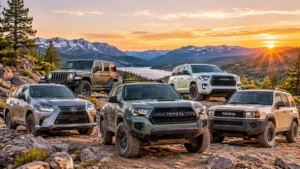
A four-wheel-drive SUV is a long-term purchase, so power and trail gear matter less than whether it will keep running without constant, costly repairs. A dependable 4WD SUV needs a proven engine, a durable drivetrain, sensible service costs and the capability you actually use.
Toyota, Lexus and Jeep offer the best-known options. Reliability, however, changes with generation, engine and model year. A famous nameplate doesn’t guarantee that its newest version will be equally trouble-free.
The Toyota 4Runner is among the strongest midsize picks for long-term durability, the Toyota Land Cruiser is a standout large SUV, and the Lexus GX is a strong luxury alternative. The Jeep Wrangler suits drivers who put trail ability first, and the Toyota Sequoia suits families who need space.
This guide compares the evidence, drivetrains and ownership factors behind each.
Key Takeaways
- The Toyota 4Runner has some of the best longevity data of any midsize SUV.
- The Toyota Land Cruiser pairs full-time 4WD with a strong durability reputation, though its current hybrid powertrain is new.
- The Lexus GX adds luxury to genuine off-road hardware.
- The Jeep Wrangler excels off-road, but capability is not the same as reliability.
- The Toyota Sequoia leads iSeeCars’ 2026 SUV longevity ranking.
- For used SUVs, service history and the exact powertrain matter more than the badge.
Which Is the Most Reliable 4WD SUV?
For midsize buyers, the Toyota 4Runner is the safest bet, backed by one of the strongest longevity results in its class. Among large SUVs, the Land Cruiser and Sequoia are the leading Toyotas, though they rest on different kinds of evidence, explained below.
No single model suits everyone. The right answer depends on generation, drivetrain, maintenance record and how you plan to drive.
Best and Most Reliable 4WD SUVs
1. Toyota 4Runner

The Toyota 4Runner uses body-on-frame construction, available low-range 4WD and trail-focused trims, making it a favorite with owners who keep vehicles for many years.
The 2026 model uses a turbocharged 2.4-liter four-cylinder making 278 horsepower and 317 lb-ft of torque. An i-FORCE MAX hybrid version produces up to 326 horsepower and 465 lb-ft. Depending on trim, buyers can choose rear-wheel drive, part-time 4WD or full-time 4WD, and some versions add a two-speed transfer case and locking rear differential.
Best for: everyday driving plus regular off-road use
Strengths
- Excellent longevity record.
- Available low-range gearing.
- TRD Pro and Trailhunter off-road trims.
- Practical cabin and cargo space.
- Optional hybrid power.
Watch for: The generation introduced for 2025 is new, with a different engine lineup. It lacks the decades of history older 4Runners have. Used buyers should inspect the engine, transmission, suspension, underbody and 4WD components.
2. Toyota Land Cruiser

The Land Cruiser’s reputation comes from decades of global use in demanding conditions. The current US model blends that heritage with a comfortable cabin.
The 2026 version uses the i-FORCE MAX hybrid: a 2.4-liter turbo engine, an electric motor and an eight-speed automatic. Output is 326 horsepower and 465 lb-ft. Full-time four-wheel drive with a two-speed transfer case is standard.
Best for: long trips and difficult terrain
Strengths
- Long-established durability image.
- Full-time 4WD and low range.
- Strong low-speed torque.
- Advanced off-road driving aids.
- Comfortable on long journeys.
Watch for: The hybrid powertrain differs from earlier Land Cruisers, so older reliability stories don’t automatically transfer. It also isn’t ranked in the iSeeCars longevity study, and parts and service can cost more than for mainstream SUVs.
3. Lexus GX
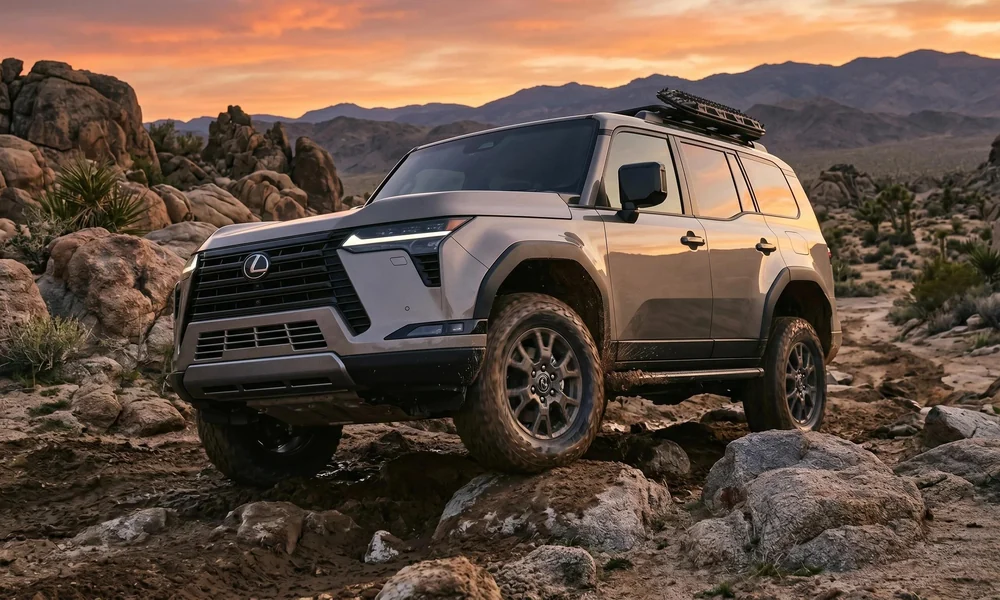
The GX blends a premium interior with traditional truck-style construction.
The 2026 GX 550 has a 3.4-liter twin-turbo V6 making 349 horsepower, a 10-speed automatic and full-time 4WD. It includes a two-speed transfer case and locking center differential, and Overtrail trims add equipment for tougher terrain.
Best for: luxury with real off-road hardware
Strengths
- Full-time four-wheel drive.
- Strong twin-turbo V6.
- Body-on-frame construction.
- Refined, comfortable cabin.
- Useful towing ability.
Watch for: The GX 550 replaced the V8-powered GX 460 for 2024, so it has less history. Evaluate the two generations separately. In the iSeeCars study, the GX shows a 23.3% estimated chance of reaching 250,000 miles, though that figure reflects mostly earlier vehicles.
4. Jeep Wrangler

Few vehicles match the Wrangler’s trail focus. Engine choices vary by model year and trim, typically including a 3.6-liter V6 and a turbocharged 2.0-liter four-cylinder. Command-Trac and Rock-Trac systems offer selectable 4WD with low range, and Rubicon models add locking differentials and heavy-duty off-road components.
Best for: serious trail driving
Strengths
- Exceptional trail capability.
- Low-range 4WD.
- Rubicon-specific equipment.
- Many configurations.
- Removable roof and doors on applicable versions.
Watch for: Capability does not mean low ownership costs. Independent reliability surveys have often rated Wranglers below the Toyota and Lexus models here, and results vary by year, engine and transmission. Inspect steering, suspension, the transfer case and the underbody, especially on used examples.
5. Toyota Sequoia

The Toyota Sequoia is a full-size SUV that offers three rows, strong towing capacity and a hybrid powertrain. The 2026 model pairs a twin-turbo 3.4-liter V6 with an electric motor, delivering 437 horsepower and 583 lb-ft through a 10-speed automatic. Four-wheel drive is available on selected configurations.
Best for: large families and towing
Strengths
- Roomy three-row interior.
- Powerful hybrid system.
- Available 4WD.
- High towing capacity when equipped.
Watch for: The Sequoia tops iSeeCars’ 2026 SUV ranking at 42.3%, but that data largely reflects older V8 models. The current hybrid is newer, so judge it separately. Its size also raises fuel and tire costs.
Comparison of the Most Reliable 4WD SUVs
| SUV | Engine | Power | 4WD system | Best suited for |
|---|---|---|---|---|
| Toyota 4Runner | 2.4L turbo I-4 / hybrid | 278 / 326 hp | Part-time or full-time, by trim | Everyday and off-road use |
| Toyota Land Cruiser | 2.4L turbo hybrid | 326 hp | Full-time 4WD | Long trips and rough terrain |
| Lexus GX 550 | 3.4L twin-turbo V6 | 349 hp | Full-time 4WD | Luxury and off-road use |
| Jeep Wrangler | Varies | Varies | Selectable 4×4 systems | Serious off-roading |
| Toyota Sequoia | 3.4L twin-turbo hybrid V6 | 437 hp | Available 4WD | Families and towing |
Specifications refer to 2026 US-market models and vary by configuration. The table compares specs, not reliability.
Which 4WD SUVs Can Last 250,000 Miles?

Longevity and reliability overlap but aren’t identical. Longevity asks whether a vehicle stays on the road; reliability asks how often it needs repair along the way.
iSeeCars’ 2026 study, which analyzed odometer data from millions of SUVs, estimates a 33.1% chance that a 4Runner reaches 250,000 miles, against roughly 6% for the average midsize SUV. It puts the Lexus GX at 23.3% and the Sequoia at 42.3%, the highest SUV result. These are statistical estimates, not promises for any single vehicle.
To get the most from any 4WD SUV, watch for:
- Regular oil changes.
- Correct transmission servicing.
- Transfer case and differential fluid changes.
- Cooling system condition.
- Suspension and steering wear.
- Rust and underbody damage.
- Past towing or hard off-road use.
A well-documented SUV often beats a neglected one with fewer miles.
Most Reliable Used 4WD SUVs to Buy
| Used SUV | Main strength | What to inspect |
|---|---|---|
| Toyota 4Runner | Proven durability | Transmission, suspension, 4WD system, frame rust |
| Toyota Land Cruiser | Off-road heritage | Cooling system, drivetrain, rust |
| Lexus GX 460 | V8 and full-time 4WD | Suspension, leaks, air suspension on equipped trims |
| Jeep Wrangler | Trail equipment | Steering, suspension, transfer case, trail damage |
| Toyota Sequoia | Space and longevity data | Cooling, suspension, towing history |
Before buying, confirm:
- Complete service records.
- Accident history.
- Any sign of flood damage.
- Engine and transmission condition.
- Transfer case operation.
- Front and rear differential condition.
- Frame rust and underbody damage.
- Open recalls.
Check the VIN in the National Highway Traffic Safety Administration’s recall database. A history report helps, but an independent mechanical inspection is still essential.
4WD vs AWD: Which Is More Reliable?
Both send power to all four wheels, but they are built for different jobs. Traditional 4WD often includes a transfer case with high and low ranges for hard terrain. AWD generally manages traction between axles for wet or icy roads.
| Feature | 4WD | AWD |
|---|---|---|
| Main purpose | Off-road and rough terrain | On-road traction |
| Low-range gearing | Common | Rare |
| Off-road use | Often better suited | Depends on vehicle |
| Maintenance | Depends on design and use | Depends on design and use |
Neither is automatically more reliable. A well-kept AWD system can outlast a neglected 4WD system, so judge the specific drivetrain rather than the label.
What Makes a 4WD SUV Reliable?
Engine and transmission. Research the exact powertrain, not just the brand.
4WD components. Transfer cases, differentials, driveshafts and lockers add parts that need fluid changes and inspection, especially under hard use.
Maintenance history. Following the factory schedule, or the severe-service schedule for towing and off-roading, protects the whole drivetrain.
Model-year changes. A redesign can bring a new engine, transmission, electronics and suspension, so an excellent predecessor proves little about its successor.
Driving conditions. Heavy towing, mud, deep water, extreme heat and frequent trail use all accelerate wear.
How to Choose the Right 4WD SUV
| Your priority | SUV to consider |
|---|---|
| Daily driving plus off-road trips | Toyota 4Runner |
| Long distances and demanding terrain | Toyota Land Cruiser |
| Luxury with 4WD capability | Lexus GX |
| Serious trails | Jeep Wrangler |
| Big family and towing | Toyota Sequoia |
Also compare purchase price, warranty, fuel economy, repair costs, insurance, seating, cargo space and parts availability. The best SUV is the one that fits your needs and budget, not just the one with the strongest reputation.
How to Maintain a 4WD SUV

- Engine oil: Change oil and filter on schedule.
- Transmission fluid: Follow the service interval for your transmission.
- Transfer case and differentials: Replace fluids as scheduled, more often with towing or off-roading.
- Cooling system: Check coolant, hoses and for leaks.
- Tires: Keep the right size, pressure and even tread.
- Suspension: Inspect shocks, bushings and steering joints.
- Underbody: Wash off mud and road salt and look for rust.
Follow the maintenance schedule for your exact model, engine and drivetrain, and prioritize regular vehicle maintenance, including timely oil changes, fluid checks and routine inspections, to prevent avoidable repairs.
Frequently Asked Questions
Is an older 4WD SUV more reliable than a new one?
Not necessarily. Older models have a known track record, but age and wear add repair risk. Compare individual vehicles and their histories.
Can a 4WD SUV stay reliable if rarely used off-road?
Yes, but the drivetrain still needs its scheduled maintenance even if 4WD is seldom engaged.
Does driving in 4WD all the time cause damage?
It depends on the system. Full-time 4WD is designed for continuous use. Part-time systems in 4H can bind on dry, high-grip pavement, so follow the owner’s manual.
Is a V6 more reliable than a turbo four-cylinder?
Cylinder count alone doesn’t decide it. Design, maintenance and production history matter more, so research the specific engine and year.
Should I avoid a newly redesigned SUV?
Not necessarily, but new generations have less long-term data. If proven reliability matters most, a mature generation may be the safer choice.
Do larger off-road tires hurt reliability?
They can. Heavier, larger tires strain suspension, steering, brakes and drivetrain parts and affect speedometer accuracy. Stay within approved sizes or consult a specialist.
Final Verdict
The Toyota 4Runner is one of the strongest midsize choices for long-term durability and off-road ability. The Land Cruiser suits buyers wanting a larger, premium-feeling SUV with a famous heritage, and the Sequoia offers the best longevity numbers plus family space. The Lexus GX adds luxury to real four-wheel-drive hardware, while the Jeep Wrangler is the pick when trail performance outranks everything else.
Whichever you choose, compare the exact model year, engine, drivetrain and service records. A dependable SUV is one that is mechanically sound, well maintained and equipped for the way you drive.