The best 4WD vehicles offer more than extra traction. They pair a capable drivetrain with useful ground clearance, suitable tires and features that help on rough ground. Some 4WD SUVs are built for rocky trails, while others focus on comfort, space or towing.
However, two 4×4 cars with the same badge can perform very differently. Capability often changes with the trim, tires, suspension and optional packages. This guide compares leading 2026 SUVs and pickup trucks sold in the US, then explains what to check before you buy.
Best 4WD Vehicles: Quick Comparison
Some features below are limited to certain trims or packages.
| Vehicle | Type | Best for | Main strength |
|---|---|---|---|
| Jeep Wrangler | SUV | Serious off-roading | Available Rock-Trac 4×4 |
| Ford Bronco | SUV | Trail driving | Terrain modes and off-road packages |
| Toyota Land Cruiser | SUV | Trails and daily use | Full-time 4WD, two locking differentials |
| Toyota 4Runner | SUV | Families and outdoor trips | Part-time or full-time 4WD options |
| Land Rover Defender | Luxury SUV | Comfort and rough terrain | Low-range gearing and terrain technology |
| Lexus GX | Luxury SUV | Premium off-road travel | Full-time 4WD |
| Ford F-150 4×4 | Full-size pickup | Work and towing | Wide range of configurations |
| Toyota Tacoma 4×4 | Midsize pickup | Utility and recreation | Off-road-focused trims |
| Chevrolet Colorado ZR2 | Midsize pickup | Technical trails | Front and rear locking differentials |
Best 4WD SUVs and Trucks to Consider
1. Jeep Wrangler

The Jeep Wrangler is one of the strongest choices for challenging trails. Its body-on-frame construction and solid front and rear axles suit rocky, uneven ground.
Depending on the model, buyers can get a Command-Trac or Rock-Trac 4×4 system. Rock-Trac, found on the Rubicon, has a 4:1 low-range ratio for slow, controlled crawling. The Rubicon also offers Tru-Lok electronic locking differentials. When engaged, a locker makes both wheels on an axle turn together, which helps when one wheel loses grip.
Key features: Low-range gearing, front and rear lockers, an electronic front sway bar disconnect on Rubicon models, available 35-inch tires, and removable roof and doors.
Pros: Excellent trail hardware and many configurations.
Cons: Ride comfort, road noise and fuel economy may disappoint buyers who mostly drive on highways.
Best for: Drivers who put off-road ability ahead of luxury.
2. Ford Bronco
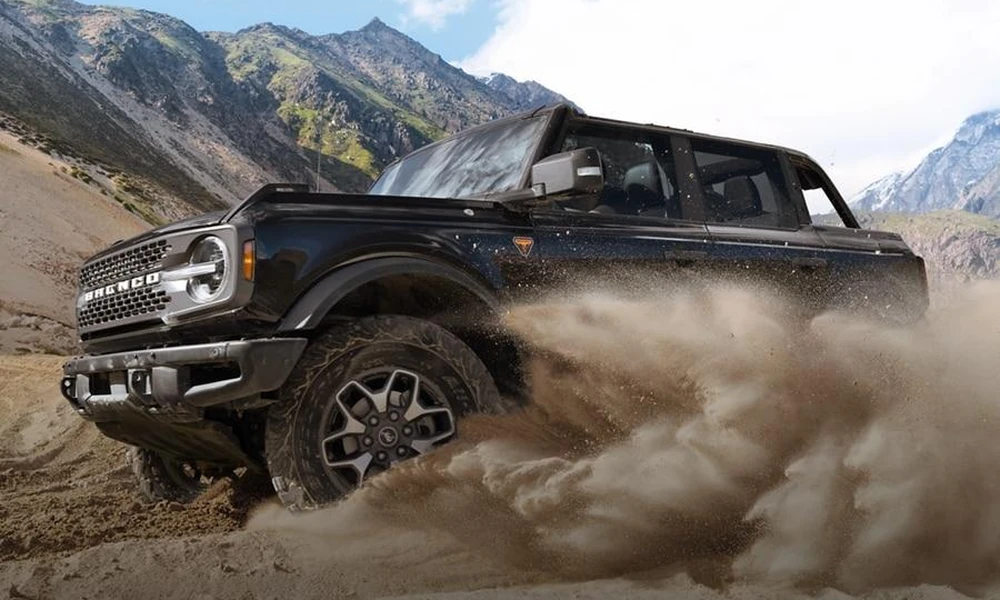
The Ford Bronco is another strong trail-focused 4×4 SUV. Its G.O.A.T. Modes, short for Goes Over Any Type of Terrain, adjust vehicle settings to suit different surfaces. The available modes vary by trim.
The Sasquatch Package adds larger tires and other off-road upgrades. With this package, ground clearance reaches 11.6 inches on two-door models and 11.5 inches on four-door models. Maximum water fording is 33.5 inches on properly equipped non-Raptor versions. The Bronco Raptor is rated higher, with 13.1 inches of clearance and up to 37 inches of water fording.
Key features: Available advanced 4×4 systems, selectable terrain modes, 35-inch tires, locking differentials, and two-door or four-door bodies.
Pros: Flexible body styles and plenty of off-road equipment.
Cons: Comfort and fuel use depend heavily on the engine, tires and configuration.
Best for: Trail driving, camping trips and recreation.
3. Toyota Land Cruiser

The Toyota Land Cruiser balances serious off-road engineering with everyday comfort and is one of the more capable models in Toyota’s SUV lineup.The 2026 US model has an i-FORCE MAX hybrid powertrain built around a 2.4-liter turbocharged engine.
It produces 326 horsepower and 465 lb-ft of torque.Every version includes full-time 4WD, a two-speed transfer case, and center and rear locking differentials. Crawl Control, Downhill Assist Control and Multi-Terrain Select provide further help on difficult surfaces. Maximum towing is 6,000 pounds.
Pros: Generous torque, standard off-road hardware and a comfortable cabin.
Cons: It costs more than many mainstream SUVs, and the trim selection is limited.
Best for: Long outdoor journeys combined with daily driving.
4. Toyota 4Runner

The Toyota 4Runner is a practical midsize SUV for families and outdoor enthusiasts, with a rugged design suited to challenging terrain. Its standard 2.4-liter turbocharged engine makes 278 horsepower and 317 lb-ft of torque. The available i-FORCE MAX hybrid raises output to 326 horsepower and 465 lb-ft.
Depending on the trim, it comes with rear-wheel drive, part-time 4WD or full-time 4WD. An electronic locking rear differential is standard on TRD Off-Road, TRD Pro and Trailhunter models. Selected configurations seat up to seven people.
Pros: Broad trim choice, practical packaging and capable off-road versions.
Cons: Not every 4Runner has 4WD, and trail equipment differs considerably.
Best for: Buyers who need one SUV for family duties and weekend adventures.
5. Land Rover Defender

The Land Rover Defender combines a premium cabin with genuine off-road ability, supported by its available low-range gearing and terrain technology. Land Rover describes its drivetrain as all-wheel drive, but a twin-speed transfer box provides both high and low ranges.
Depending on the version and options, equipment includes Terrain Response 2, Wade Sensing and an electronic active differential. Terrain settings help the vehicle adapt to changing surfaces, while Wade Sensing helps the driver monitor water depth. Hill descent technology assists on steep slopes.
Pros: Comfort, advanced technology and low-range capability.
Cons: Purchase and ownership costs can be high.
Best for: Buyers who want luxury without giving up trail ability.
6. Lexus GX
The Lexus GX is a body-on-frame luxury SUV with standard full-time 4WD. The 2026 GX 550 uses a twin-turbocharged 3.4-liter V6 that delivers 349 horsepower and 479 lb-ft of torque.
Maximum towing reaches 9,096 pounds on the Overtrail trim, while several other versions have lower ratings. The Overtrail and Overtrail+ add trail-focused equipment, including an electronic locking rear differential. These two models seat five, whereas other GX trims offer seven seats.
Pros: A refined interior, strong performance and useful off-road technology.
Cons: Fuel and purchase costs are significant, and Overtrail models lack a third row.
Best for: Drivers seeking a luxurious, trail-ready SUV.
7. Ford F-150 4×4

The Ford F-150 4×4 is a full-size pickup suited to work, towing and daily transport. The 2026 range includes 2.7-liter and 3.5-liter EcoBoost V6 engines, a 5.0-liter V8 and a 3.5-liter PowerBoost hybrid, with availability varying by model.
Ford lists a maximum towing rating of 13,500 pounds. Only a specific, properly equipped configuration reaches it, so check the rating for the exact truck. Tremor and Raptor versions provide additional off-road focus.
Pros: Strong towing potential, a useful bed and many cab, bed and powertrain choices.
Cons: Its size can complicate parking, and fuel consumption may be high.
Best for: Owners who need a work truck that can also handle recreation.
8. Toyota Tacoma 4×4

The Toyota Tacoma 4×4 is a midsize alternative to a full-size pickup. It uses a 2.4-liter turbocharged engine, with an i-FORCE MAX hybrid available on selected models.
Drivetrains vary by trim. Many 4WD versions use a part-time system, while the Limited offers full-time 4WD. TRD Off-Road and TRD Pro models deserve attention for trail use. Depending on the version, equipment includes an electronic locking rear differential, Crawl Control and specialized suspension.
Pros: Practical bed space and several off-road-oriented choices.
Cons: Passenger and cargo room depend on the cab and bed combination.
Best for: Outdoor activities and everyday utility in a midsize package.
9. Chevrolet Colorado ZR2

The Chevrolet Colorado ZR2 is designed for demanding trails. It features front and rear electronic locking differentials, a two-speed transfer case, specialized off-road suspension and hill descent control. The ZR2 Bison adds further upgrades, including extra underbody protection and 35-inch tires.
Pros: Serious factory off-road hardware in a pickup.
Cons: Its short bed may not suit buyers with large loads.
Best for: Technical trail driving with pickup versatility.
How to Choose the Best Four by Four SUV or Truck
There is no single winner for every driver. For rock crawling, start with the Wrangler Rubicon. For family use, consider the 4Runner. The Land Cruiser suits mixed travel, while the GX adds luxury. Choose the F-150 for heavy towing, or compare the Tacoma and Colorado for a smaller truck. These are use-based suggestions rather than test results or reliability rankings.
4WD vs AWD: What Is the Difference?
Both systems can send power to all four wheels. Traditional 4WD often uses a transfer case with high and low ranges, and many systems let the driver select modes. AWD usually manages power automatically and is common on road-focused vehicles.
The labels do not tell the whole story, as the Defender shows. For serious trails, look for low-range gearing, suitable clearance and good traction hardware. For mostly paved roads and changing weather, AWD may be more convenient. Neither system replaces appropriate tires or careful driving. Extra driven wheels also do not shorten braking distances on their own.
Types of Four-Wheel-Drive Systems
Part-Time 4WD
Part-time systems let the driver switch between two-wheel and four-wheel drive. Common settings include:
- 2H: Two-wheel drive for normal road use.
- 4H: High-range 4WD for suitable loose or slippery surfaces.
- 4L: Low-range 4WD for slow, demanding terrain.
Do not normally use a part-time system in 4WD on dry, high-grip pavement, as this can strain the drivetrain. Follow the owner’s manual when changing modes.
Full-Time 4WD
Full-time 4WD powers all four wheels continuously. A center differential or similar device lets the front and rear axles turn at different speeds in corners. Some vehicles can also lock the center differential for low-traction conditions.
Automatic 4WD
Automatic 4WD adjusts power delivery as traction changes. Its design and off-road ability vary between manufacturers.
Important 4WD Features to Check
A rugged appearance does not prove capability. Even among the best rugged SUVs, specifications differ between trims.
| Feature | Why it matters |
|---|---|
| Ground clearance | More clearance helps the underside avoid obstacles |
| Approach angle | A larger angle helps the front clear steeper obstacles |
| Departure angle | A larger angle reduces the chance of rear-end contact |
| Breakover angle | A larger angle helps the middle clear ridges |
| Low-range gearing | Adds control and torque at the wheels at low speeds |
| Locking differentials | Help maintain progress when a wheel loses grip |
| Suitable tires | Strongly influence grip on each surface |
| Underbody protection | Helps shield vulnerable components |
Treat water-fording figures as limits under specified conditions, not guarantees. Moving water, hidden obstacles and unstable ground can make a crossing unsafe even when it appears shallow.
Are 4WD Cars Good for Everyday Driving?
Many 4WD cars and SUVs work well for commuting, family travel and highway trips. Comfort and running costs depend on size, suspension, tires and powertrain.
Large off-road models can be harder to park and may use more fuel than road-focused alternatives. Aggressive mud-terrain tires can add noise and change how a vehicle rides and handles. If you rarely leave paved roads, choose manageable dimensions, comfortable seats and useful safety technology over equipment you may never use.
What to Consider Before Buying
Your Needs and Budget
List your usual roads, passengers, cargo and towing loadsThen compare purchase price, insurance, fuel, tires, maintenance and financing to estimate the overall cost of ownership.. A cheaper vehicle is not always less expensive to own.
Reliability and Safety
Shoppers looking for reliable 4WD SUVs should research the exact model year, engine and drivetrain. Review recall records, warranty coverage, maintenance requirements and independent reliability data. A brand’s reputation cannot guarantee the performance of every model.
Also compare crash-test results and driver-assistance features. When comparing top rated 4×4 SUVs, check what each rating measures, since safety, reliability and off-road scores answer different questions.
New vs Used 4×4 Cars
A used 4×4 can offer good value, but its history matters. Before buying, check:
- Transfer case operation and 4WD engagement.
- Front and rear differentials for leaks or unusual noise.
- Suspension and steering wear.
- Underbody damage and rust.
- Tire condition and wheel alignment.
- Service, accident and recall history.
Arrange a professional inspection, especially if there are signs of heavy off-road use.
Advantages and Disadvantages of 4WD Vehicles
| Advantages | Disadvantages |
|---|---|
| Better traction on suitable surfaces | Often costs more to buy |
| Greater ability on difficult terrain | May use more fuel |
| Useful for outdoor and work tasks | More drivetrain parts to maintain |
| Low range available on many models | Specialized tires can be expensive |
Frequently Asked Questions
Is 4×4 the same as 4WD?
Shoppers and manufacturers commonly use both terms for four-wheel drive. The actual hardware can differ, so compare specifications rather than badges.
Can I leave a vehicle in 4WD all the time?
Full-time 4WD is designed for continuous use. Many part-time systems should be engaged only on suitable loose or slippery surfaces. Your owner’s manual gives the correct guidance.
Do 4WD vehicles need matching tires?
Follow the manufacturer’s requirements. Matching size, type and similar tread depth is generally important. Differences in tire circumference can strain some drivetrains.
Should I use low range on snowy roads?
Usually not for normal road driving. Low range is intended for slow situations needing extra control, such as steep climbs or deep loose terrain. Select the mode your manual recommends.
Can a 4WD vehicle still get stuck?
Yes. Deep mud, unsuitable tires, limited clearance or an underside resting on the ground can stop even a capable vehicle.
Is a locking differential better than more engine power?
When one wheel has little grip, a locker can often help more than extra horsepower. The best setup still depends on the terrain.
What should I check after driving through mud or water?
Inspect the underbody, brakes, tires and visible suspension parts for debris or damage. Follow the recommended cleaning and service steps, especially after deep-water crossings.
Final Thoughts
The best 4WD vehicles match their equipment to your real driving needs. The Wrangler and Bronco stand out for trail adventures, while the Land Cruiser and 4Runner offer strong everyday versatility. The Defender and GX appeal to luxury buyers. For pickup practicality, compare the F-150, Tacoma and Colorado ZR2.
Before choosing any four wheel drive SUV or truck, confirm the exact model year, trim and options. Take a test drive, calculate ownership costs and make sure the vehicle suits where you actually travel.