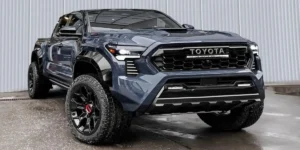
If you are shopping for a Tacoma, the MPG number on the window sticker can look simple until you compare actual configurations. A rear-wheel-drive SR5 can be rated differently from a four-wheel-drive TRD Off-Road, while the i-FORCE MAX hybrid brings more power without raising the best combined rating above 23 mpg.
That is why Toyota Tacoma MPG is better understood by engine, drivetrain, trim, and model year rather than by one number.
The current 2026 Tacoma reaches up to 23 mpg combined, with ratings as high as 21 city and 26 highway on certain gas models. Toyota also lists the i-FORCE MAX hybrid at up to 23 mpg combined.
Quick Answer: Toyota Tacoma MPG at a Glance
The 2026 Toyota Tacoma achieves up to 23 mpg combined, depending on configuration. Certain rear-wheel-drive gas models reach 21 city/26 highway, while the i-FORCE MAX hybrid reaches up to 23 city/24 highway and 23 combined. Four-wheel-drive, manual-transmission, and off-road configurations generally have lower ratings. Your actual MPG can also change with speed, traffic, tires, cargo, weather, and driving style.
Key Takeaways
- The best current Toyota Tacoma MPG rating is 23 mpg combined.
- Certain rear-wheel-drive gas Tacomas reach 21 city/26 highway.
- The i-FORCE MAX hybrid reaches up to 23 city/24 highway/23 combined on the Limited.
- Gas four-wheel-drive automatic models commonly rate around 19–20 city/23–24 highway/21 combined.
- Six-speed manual configurations are rated around 18 city/23 highway/20 combined.
- Car and Driver recorded 22 mpg at 75 mph with a TRD Off-Road in its highway test.
- Your personal MPG can differ substantially from EPA estimates because of driving conditions and vehicle configuration.
How Many MPG Does a Toyota Tacoma Get?
The 2026 Toyota Tacoma gets up to 23 mpg combined, with the most efficient gas models rated as high as 21 mpg city and 26 mpg highway. The i-FORCE MAX hybrid can also reach 23 mpg combined, while many four-wheel-drive gas versions are rated around 21 mpg combined. Exact MPG depends on trim, drivetrain, transmission, tires, and equipment.
What Is the Toyota Tacoma MPG for 2026?
For 2026, the Tacoma’s published fuel-economy range depends heavily on how the truck is configured.
The standard 2.4-liter turbocharged i-FORCE engine can reach 26 mpg highway, while the available i-FORCE MAX hybrid has an EPA-estimated 23 mpg combined rating. Toyota lists the hybrid with up to 326 horsepower and 465 lb-ft of torque.
Here is the practical picture:
| Tacoma configuration | City | Highway | Combined |
| Best gas RWD automatic | 20–21 mpg | 26 mpg | 23 mpg |
| Gas 4WD automatic | 19–20 mpg | 23–24 mpg | 21–22 mpg |
| Six-speed manual | 18 mpg | 23 mpg | 20 mpg |
| i-FORCE MAX hybrid | 22–23 mpg | 24 mpg | 23 mpg |
The exact number can change with cab, bed, drivetrain, wheels, tires, and equipment. For that reason, check the window sticker for the specific Tacoma you are considering.
Toyota’s current model information shows, for example, the SR at 20/26 mpg, the SR5 at 21/26 mpg, and the TRD Off-Road at 18/23 mpg in the listed configurations.
What Does MPG on a Toyota Tacoma Actually Mean?
MPG means miles per gallon. In simple terms, it tells you how many miles the truck is expected to travel on one gallon of gasoline under standardized testing.
EPA figures are useful for comparing vehicles, but they are not guarantees for your daily driving.
The EPA notes that speed, driving style, weather, traffic, road conditions, cargo, and accessories can all affect real-world fuel economy.
Toyota Tacoma MPG by Engine
The biggest change in the fourth-generation Tacoma is its move away from the previous V6-centered lineup.
The current truck uses a 2.4-liter turbocharged four-cylinder in i-FORCE form, while the available i-FORCE MAX adds hybrid assistance.
2.4L i-FORCE Gas Engine
The standard i-FORCE produces up to 278 horsepower and 317 lb-ft of torque.
Toyota lists the engine with an EPA-estimated highway rating of up to 26 mpg in the most efficient configuration.
That does not mean every gas Tacoma gets 26 mpg highway. Four-wheel drive, tires, trim, transmission, and other equipment can lower the rating.
2.4L i-FORCE MAX Hybrid
The i-FORCE MAX combines the turbocharged 2.4-liter engine with electric assistance.
It produces up to 326 horsepower and 465 lb-ft of torque, while Toyota lists an EPA-estimated 23 mpg combined rating.
The important point is that the hybrid’s biggest advantage is not necessarily a higher combined MPG number.
Instead, it can provide stronger performance and higher city fuel-economy ratings on certain configurations.
i-FORCE vs. i-FORCE MAX: Which Gets Better MPG?
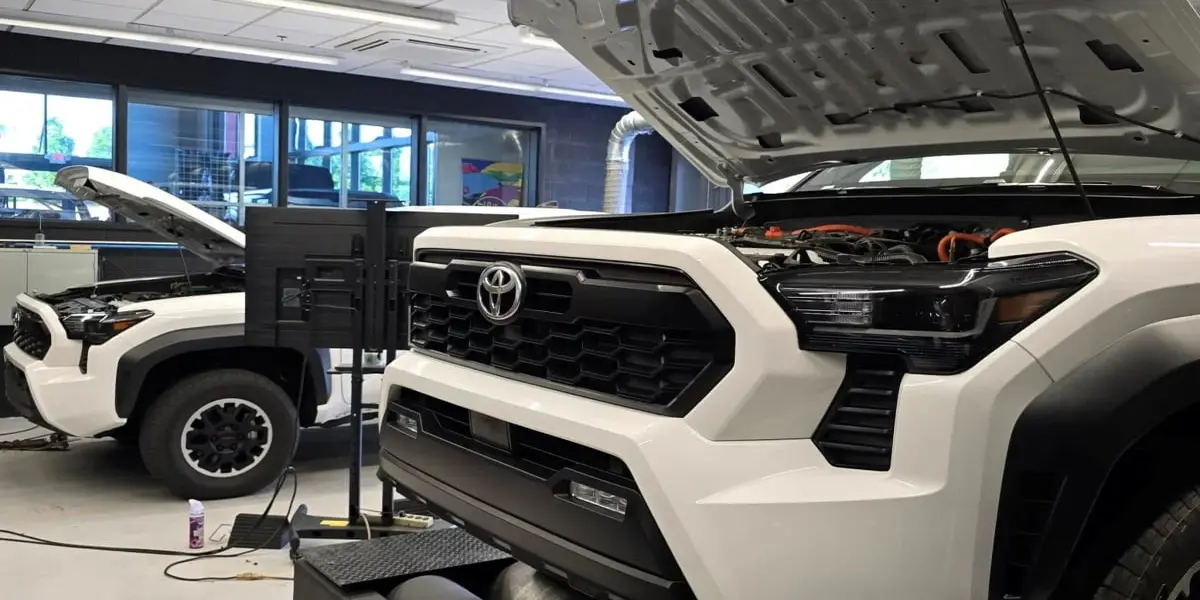
If your only goal is the highest combined MPG, do not assume the hybrid automatically wins.
The best gas and hybrid configurations can both reach 23 mpg combined.
The difference becomes clearer when you look at city driving and performance. Toyota lists the Limited i-FORCE MAX at 23 city/24 highway, while several gas configurations have lower city ratings.
Toyota Tacoma Gas Mileage by Trim
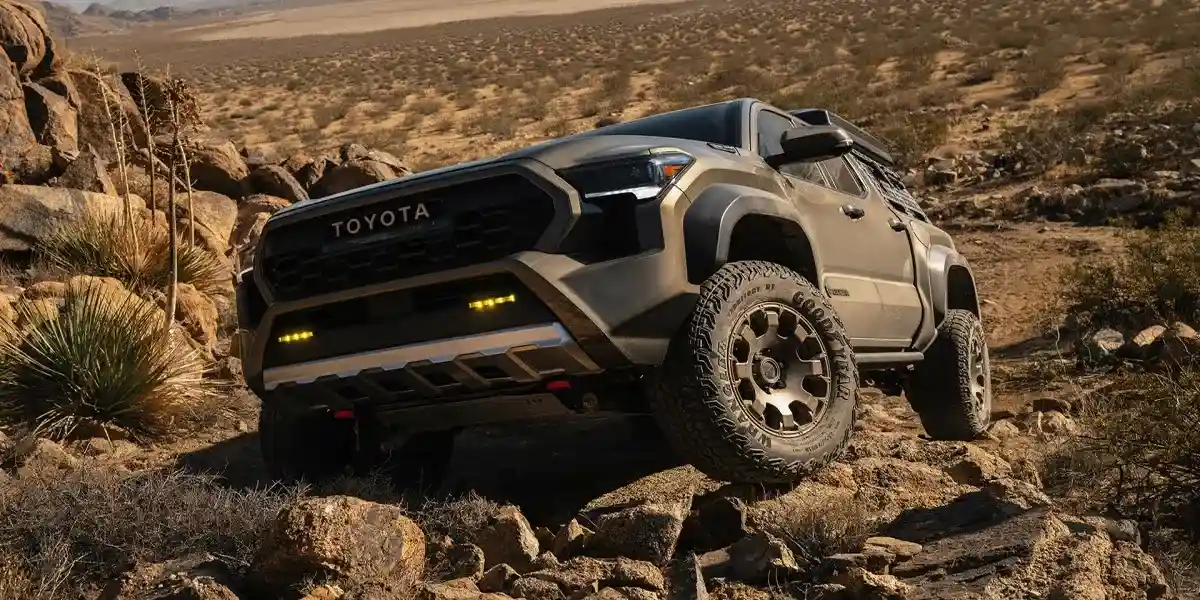
Trim selection can change Tacoma fuel economy because each version can bring different drivetrains, wheels, tires, and equipment.
| Trim/example | Powertrain | Listed MPG |
| SR | i-FORCE gas | 20/26 mpg |
| SR5 | i-FORCE gas | 21/26 mpg |
| TRD PreRunner | i-FORCE gas | 20/24 mpg |
| TRD Sport | i-FORCE gas | 20/24 mpg in listed RWD configuration |
| TRD Off-Road | i-FORCE gas | 18/23 mpg |
| Limited | i-FORCE gas | 20/23 mpg |
| TRD Sport i-FORCE MAX | Hybrid | 22/24 mpg |
| TRD Off-Road i-FORCE MAX | Hybrid | 22/24 mpg |
| Limited i-FORCE MAX | Hybrid | 23/24 mpg |
Toyota’s current 2026 listings show these city/highway ratings for the corresponding configurations.
Which Tacoma Trim Gets the Best MPG?
If fuel economy is your priority, the SR5 rear-wheel-drive automatic is one of the strongest choices, with a listed 21 city/26 highway rating.
The SR reaches 20 city/26 highway, while the hybrid Limited reaches 23 city/24 highway.
So there is no single “best” Tacoma for every type of driving.
For highway mileage, the gas RWD SR and SR5 are particularly strong. For city driving, the hybrid can make more sense.
Toyota Tacoma MPG by Model Year
The Tacoma’s fuel-economy story changed significantly when the fourth generation arrived for 2024.
2024 Toyota Tacoma MPG
The 2024 Tacoma introduced the current turbocharged four-cylinder family.
The EPA database listed a Tacoma configuration at 21 city, 26 highway, and 23 combined mpg.
That generation also introduced the available i-FORCE MAX hybrid, replacing the previous generation’s engine strategy with a turbo-four and hybrid option.
2025 Toyota Tacoma MPG
The 2025 Tacoma continued the fourth-generation powertrain approach.
Car and Driver reported EPA estimates as high as 21 city and 26 highway for two-wheel-drive versions, while four-wheel-drive versions reached up to 20 city and 23 highway in its published information.
2026 Toyota Tacoma MPG
The 2026 model continues the same basic turbocharged 2.4-liter i-FORCE and i-FORCE MAX powertrain strategy.
Toyota’s current listings show the most efficient configurations reaching 23 mpg combined, while the TRD Off-Road gas model is listed at 18 city/23 highway.
The 2026 changes are mainly equipment, styling, colors, wheels, tires, and trim updates rather than a major MPG redesign.
What About Older Tacoma Model Years?
Older Tacomas used different engines and configurations, so you should not apply today’s MPG figures to them.
The Tacoma began with the 1995 model year as the successor to Toyota’s U.S.-market Pickup. Its generations changed in 2005, 2016, and 2024, bringing different engines, dimensions, and equipment.
For an older used Tacoma, the exact model year, engine, transmission, drivetrain, and configuration matter more than the Tacoma name alone.
How Good Is Toyota Tacoma Fuel Economy in Real-World Driving?
EPA numbers give you a useful baseline, but real-world testing shows why you should leave some room for variation.
Car and Driver recorded 22 mpg on its 75-mph highway fuel-economy route with a TRD Off-Road.
That is close to the official rating for the tested configuration, but it still does not mean every owner will achieve 22 mpg.
The same publication’s testing also demonstrates how configuration and conditions matter. Its published Tacoma data includes observed results that differ from EPA ratings.
The hybrid can vary just as much.
Car and Driver reported 17 mpg in a 75-mph highway test with a Tacoma Hybrid Trailhunter, whose off-road equipment and tires are not particularly favorable for fuel economy.
That is a useful reminder: hybrid does not automatically mean maximum MPG in every configuration.
Why Does Your Tacoma Get Different MPG Than the Sticker?
Your truck may use more fuel than its EPA estimate for completely normal reasons.
Tires and Wheels
Aggressive all-terrain tires can increase rolling resistance.
This matters particularly on off-road-oriented trims, where larger tires and specialized equipment can trade some fuel economy for traction and capability.
Four-Wheel Drive
Four-wheel-drive hardware adds weight and mechanical resistance.
The current gas 4WD Tacoma examples generally sit below the most efficient RWD configurations in EPA ratings.
Towing and Payload
A loaded truck needs more energy to move.
Towing can also create significant aerodynamic drag, particularly at highway speeds. There is no single Tacoma towing-MPG penalty because trailer size, speed, terrain, wind, and load all change the result.
Speed and Driving Style
Highway speed matters more than many drivers expect.
Hard acceleration, frequent braking, high speeds, and extended idling can all reduce fuel economy compared with controlled EPA testing.
Weather and Short Trips
Cold weather, hills, traffic, air-conditioning use, and repeated short trips can also change your results.
That is why a single tank should not be treated as proof of your truck’s normal MPG.
Who Should Choose a Fuel-Efficient Tacoma?
A higher-MPG Tacoma makes the most sense if you spend a lot of time commuting, travel long highway distances, or rarely need aggressive off-road equipment.
A rear-wheel-drive gas configuration can be particularly attractive when your priority is highway fuel economy.
The hybrid is worth considering when you want more power and spend substantial time in city driving.
Who Should Avoid Choosing a Tacoma Mainly for MPG?
If fuel economy is your only priority, a midsize pickup is unlikely to be the ideal vehicle category.
The Tacoma is built around utility, ground clearance, towing, payload, and off-road capability. Its roughly 20–23 mpg combined range is reasonable for a gasoline midsize pickup, but it is not passenger-car hybrid territory.
In other words, do not buy a Tacoma expecting Prius-like fuel economy.
Buy it when you need what a Tacoma is designed to provide, then choose the configuration that minimizes the fuel penalty for your use.
How to Improve MPG on a Toyota Tacoma
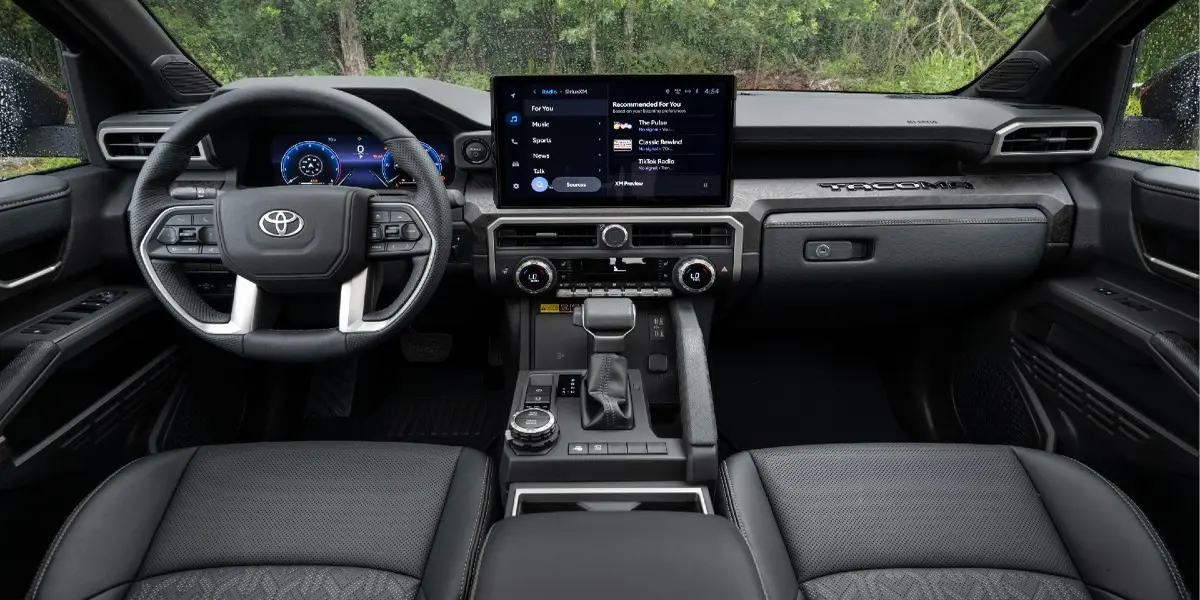
You do not need complicated modifications to start improving fuel economy.
1. Check Tire Pressure Regularly
Use the recommended tire pressure rather than guessing.
Underinflated tires can increase rolling resistance and hurt fuel economy.
2. Reduce Unnecessary Weight
If you carry tools, equipment, camping gear, or other cargo that you do not need every day, removing it can reduce the truck’s workload.
3. Avoid Unnecessary Idling
Idling consumes fuel without adding miles.
If you are stopped for an extended period, unnecessary engine operation works directly against your MPG.
4. Drive Smoothly
Gradual acceleration and braking are generally more efficient than aggressive driving.
High-speed highway driving can also reduce fuel economy compared with moderate speeds.
5. Measure Your Own MPG
The simplest method is:
- Fill the tank.
- Record the odometer or trip reading.
- Drive normally.
- Fill the tank again.
- Divide miles driven by gallons added.
- Repeat over several tanks.
Several fill-ups give you a much more useful picture than one unusually good or bad trip.
Common Toyota Tacoma MPG Mistakes to Avoid
The biggest mistake is comparing two Tacomas without checking their configurations.
A RWD SR5 and a 4WD TRD Off-Road may look similar in a basic MPG search, but their official ratings can be quite different.
Another mistake is treating the hybrid’s 23 mpg combined rating as automatically better than every gas Tacoma.
The best gas models can also reach 23 mpg combined.
Finally, do not judge your truck from one tank. Weather, traffic, cargo, tires, and driving style can temporarily move your MPG well above or below your normal average.
Practical Application: How to Choose the Right Tacoma for MPG
Start with your driving pattern rather than the trim badge.
If most of your miles are highway commuting, look first at a rear-wheel-drive automatic configuration with the strongest highway rating.
If you spend more time in city traffic and also want extra performance, compare the i-FORCE MAX configurations.
If you need serious off-road capability, accept that equipment such as aggressive tires and additional hardware can come with a fuel-economy trade-off.
Finally, compare the exact truck’s window sticker before buying. The VIN-specific rating is more useful than a generic “Tacoma MPG” number because cab, bed, drivetrain, wheels, tires, and transmission can all change the result.
Toyota Tacoma MPG: The Bottom Line
Picture that first comparison again: two Tacomas sitting side by side, both carrying the same badge but built for different jobs. One may prioritize highway efficiency, while the other trades some MPG for four-wheel drive, tougher tires, and off-road capability.
That is the real lesson behind Toyota Tacoma MPG.
The current 2026 Tacoma can reach 23 mpg combined, but the path to that number depends on configuration. The gas RWD models can deliver excellent highway economy, while the i-FORCE MAX adds power and strong city efficiency without exceeding 23 mpg combined.
Real-world results will always move around the EPA figure. Car and Driver’s 22-mpg highway result with a TRD Off-Road shows that official numbers can be realistic, but other configurations and conditions can produce very different results.
The smartest Tacoma MPG choice is therefore not simply the truck with the biggest number. It is the configuration that gives you the capability you actually need without paying a fuel-economy penalty for equipment you will rarely use.
Toyota Tacoma MPG FAQs
What is the MPG on a Toyota Tacoma?
The 2026 Toyota Tacoma reaches up to 23 mpg combined in certain configurations. The most efficient gas versions can reach 21 city and 26 highway, while the i-FORCE MAX hybrid can reach up to 23 city, 24 highway, and 23 combined.
Which Toyota Tacoma gets the best gas mileage?
The 2026 Tacoma SR5 rear-wheel-drive automatic is listed at approximately 21 city/26 highway/23 combined mpg. The SR is listed at 20 city/26 highway/23 combined, so both are among the most efficient gas configurations.
Is the Tacoma hybrid more fuel-efficient?
The i-FORCE MAX hybrid can provide stronger city fuel economy than many gas four-wheel-drive configurations. However, its maximum combined rating is 23 mpg, which matches the best gas Tacoma rather than exceeding it.
Does four-wheel drive reduce Tacoma MPG?
Generally, yes. Current gas four-wheel-drive automatic Tacomas are commonly rated around 19–20 city, 23–24 highway, and 21 combined mpg, depending on configuration. The lower ratings reflect differences in drivetrain and equipment.
What MPG does the Tacoma TRD Off-Road get?
The current gas TRD Off-Road is listed at about 18 city/23 highway in Toyota’s current configuration information. Car and Driver recorded 22 mpg during a 75-mph highway test with a TRD Off-Road, showing why real-world results can differ from the EPA rating.
What is the Tacoma manual-transmission MPG?
The six-speed manual configuration is approximately 18 city/23 highway/20 combined mpg. Toyota continues to offer the manual on selected i-FORCE configurations, making the Tacoma unusual among current midsize pickups.
How can I improve Tacoma gas mileage?
Keep the tires properly inflated, remove unnecessary cargo, avoid extended idling, drive smoothly, and limit unnecessary high-speed driving. For a reliable personal number, calculate MPG across several fill-ups rather than relying on a single dashboard reading.