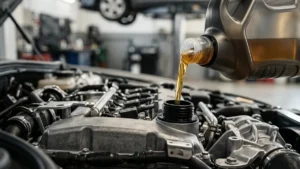
Your car’s engine can overheat without motor oil, grind metal against metal, and suffer permanent damage within minutes. Understanding how oil works and choosing the right engine oil helps your car run smoothly and saves you from costly repairs.
This guide covers everything you need to know: how engine oil works, the differences between oil types, how to read bottle labels, ideal change intervals, signs of low oil, and proper disposal.
Key Takeaways
- Always check your owner’s manual: Use the exact viscosity grade and oil specification recommended by your vehicle manufacturer.
- Motor oil performs five core duties: It lubricates moving parts, cools internal components, cleans harmful deposits, protects against rust and corrosion, and seals combustion gaps.
- Current gasoline engine standard: API SQ and ILSAC GF-7A/GF-7B represent the latest performance standards, licensed starting March 31, 2025.
- Change intervals depend on driving habits: Hard driving, frequent short trips, and extreme temperatures require more frequent oil changes than steady highway driving.
- Act immediately on low oil warnings: If the oil warning light comes on, pull over safely and turn off the engine.
- Dispose of used oil responsibly: Never pour used engine oil down the drain or onto the ground. Take it to a recycling center that accepts used oil..
What Is Car Engine Oil?
Car engine oil is a specialized fluid made from a base oil mixed with chemical additives. Its primary job is to create a thin protective film between rapidly moving engine parts, preventing metal-on-metal friction. In addition to friction reduction, motor oil continuously cleans internal surfaces, prevents corrosion, seals piston rings, and helps carry heat away from high-temperature engine zones.
What Does Car Engine Oil Do?
Lubricates Moving Parts
Inside an internal combustion engine, components like pistons, camshafts, and crankshafts move thousands of times per minute. Motor oil creates a slippery barrier between these components, reducing friction, heat, and structural wear.
Cools the Engine
While radiator coolant thrives in cooling upper engine components, it cannot reach every moving internal part. Engine oil directly absorbs heat from lower engine areas such as the crankshaft, bearings, and underside of pistons and dissipates it as it flows back through the oil pan.
Cleans Internal Surfaces
Combustion generates carbon, soot, and microscopic debris. Motor oil contains detergent additives that suspend these dirt particles, preventing sludge formation until the oil filter can trap them.
Protects Against Rust and Acids
Fuel combustion creates acidic byproducts and water vapor. Over time, oxidation and condensation introduce moisture into the crankcase. Quality motor oils contain anti-corrosion additives that neutralize acids and protect internal metal surfaces from rust.
Seals Gaps for Compression
Motor oil fills microscopic gaps between the piston rings and cylinder walls. This fluid seal keeps high-pressure combustion gases inside the cylinder chamber, preserving engine power and fuel efficiency.
Types of Car Engine Oil
| Oil Type | Best Used For | Relative Cost | General Change Range |
| Conventional | Older vehicles, low-mileage cars | Low ($) | 3,000 – 5,000 miles |
| Synthetic Blend | Light towing, daily commuting | Moderate ($$) | 5,000 – 7,500 miles |
| Full Synthetic | Modern engines, extreme climates | Premium ($$$) | 7,500 – 15,000 miles |
| High-Mileage | Vehicles over 75,000 miles | Moderate ($$) | 5,000 – 7,500 miles |

Conventional (Mineral) Oil
Derived directly from refined crude oil, conventional oil provides basic lubrication for older vehicle designs operating under mild driving conditions.
Synthetic Blend Oil
A mixture of mineral base oil and synthetic base stock. It offers better heat resistance and breakdown protection than full conventional oil at an intermediate price point.
Full Synthetic Oil
Chemically engineered in laboratories for uniform molecular structure. Full synthetic oils offer maximum protection against extreme engine heat, cold-weather cold starts, oxidation, and sludge formation.
High-Mileage Oil
Specially formulated with seal conditioners and added anti-wear agents for engines with more than 75,000 miles. It helps swell hardened engine seals to reduce active oil leaks and oil consumption.
Synthetic vs. Conventional Car Engine Oil: Is Synthetic Worth It?
Independent automotive testing demonstrates clear advantages for synthetic formulations:
- Superior Thermal Stability: In standardized ASTM laboratory tests conducted by automotive research organizations (such as AAA), synthetic motor oils outperformed conventional oils by up to 47% in resistance to thermal degradation, deposit formation, and viscosity loss.
- Short-Trip Protection: Frequent trips under 5 miles prevent engines from reaching full operating temperature. Conventional oil under these conditions can accumulate moisture and fuel dilution, whereas synthetic oils resist sludge buildup far better.
- Specification Compliance: While conventional oil is sufficient if it meets the exact specifications listed in your owner’s manual, modern turbocharged and direct-injected engines often mandate full synthetic formulations to prevent pre-ignition and timing chain wear.
How to Read a Car Engine Oil Label
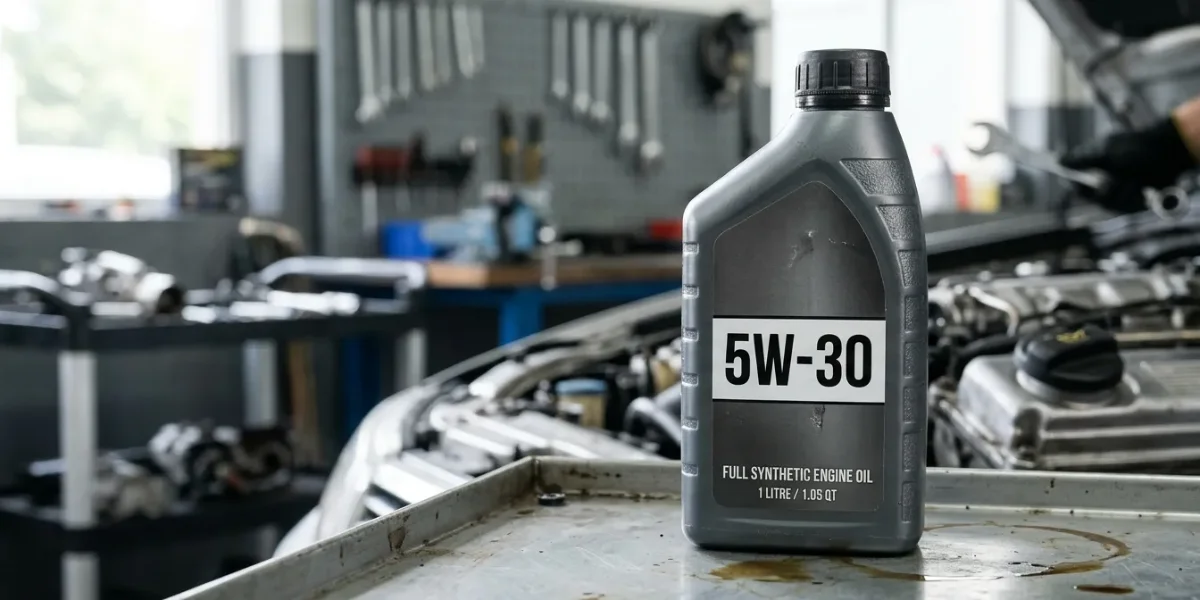
What Does 5W-30 Mean?
- 5W: The number preceding the “W” (Winter) rates cold-temperature flow properties. Lower numbers (e.g., 0W or 5W) flow faster during freezing winter startups.
- 30: The second number rates oil thickness (viscosity) at normal engine operating temperature (100°C / 212°F). A 5W-40 oil maintains a thicker fluid film at high operating temperatures than a 5W-30 oil.
API and ILSAC Marks (SQ, GF-7A, GF-7B)
- API SQ: The standard introduced by the American Petroleum Institute for spark-ignition engines. It provides strict limits against low-speed pre-ignition (LSPI), timing-chain wear, and high-temperature piston deposits.
- ILSAC GF-7A (Starburst Symbol): Applies to common viscosity grades like 0W-20, 5W-20, 0W-30, and 5W-30, focusing on fuel economy and engine durability.
- ILSAC GF-7B (Shield Symbol): Reserved exclusively for ultra-low viscosity 0W-16 oils.
- Ultra-Low Viscosity Standards: API SQ incorporates ultra-thin grades such as 0W-8 and 0W-12 designed for specific modern hybrid engines.
- Backward Compatibility: Newer standards (API SQ / GF-7) safely replace older standards like GF-5 or GF-6A in older engines, provided you maintain the recommended viscosity grade. Older GF-6 licenses were officially sunsetted as of October 1, 2026.
ACEA and European Car Maker Specs
European automakers rely on ACEA classifications (e.g., A3/B4, C3) or proprietary manufacturer approval codes (e.g., VW 507.00, BMW Longlife-04, MB 229.5). Always verify that these exact manufacturer codes appear on the bottle label.
Is a Newer Oil Specification Safe for an Older Car?
Yes. New service categories like API SQ are backward-compatible with older gasoline specs (such as API SP, SN, or SM). However, older oil formulations must never be used in newer vehicles requiring higher specifications.
How to Choose the Right Car Engine Oil for Your Car
Selection involves four basic steps:
- Check your owner’s manual: Retrieve the manufacturer requirements.
- Match the specification: Confirm required standards (API SQ, ILSAC GF-7, or European OEM code).
- Select the viscosity: Match the requested weight (e.g., 0W-20, 5W-30).
- Account for driving climate: Match low-temperature ratings to regional conditions.
Diesel Cars with a DPF Need Low-SAPS Oil
Modern diesel passenger cars equipped with a Diesel Particulate Filter (DPF) require Low-SAPS oil (low Sulphated Ash, Phosphorus, and Sulfur). Standard engine oils release metallic ash during combustion, which permanently clogs and ruins expensive DPF exhaust filters.
Thicker Oil Is Not Always Better
Using thicker oil than recommended causes higher fluid drag, reduces fuel economy, and starves critical engine components during cold starts.
How Often Should You Change Car Engine Oil?
The 3,000-Mile Rule Is Outdated
Modern engine engineering and synthetic oils have rendered the traditional 3,000-mile change interval obsolete for most modern passenger cars. Major service providers abandoned this rigid interval years ago in favor of manufacturer recommendations.
Change Intervals by Driving Conditions
| Driving Condition | Typical Change Range | Primary Risk Factors |
| Normal / Mixed Highway | 7,000 – 10,000 miles (or 1 yr) | Low stress, fully warm |
| Frequent Short Trips (<5 mi) | 4,000 – 5,000 miles | Fuel dilution, moisture |
| Severe / Stop-and-Go / Dust | 3,000 – 5,000 miles | Excessive idling, dirt |
| Modern Synthetic (Ideal Travel) | Up to 10,000 – 15,000 miles | Stable operation |
Note: Always defer to your owner’s manual recommendations first.
Oil Life Monitor (OLM)
Modern cars utilize automated Oil Life Monitoring systems. Rather than relying purely on odometer miles, the OLM tracks engine operating hours, ambient temperatures, cold starts, and payload stress to calculate true remaining oil life.
Older Cars Need Shorter Intervals
Older engines experience higher blow-by gases and minor fuel dilution, breaking down engine oil faster. Older high-mileage engines generally benefit from shorter change intervals compared to new vehicles.
Signs Your Car Engine Oil Needs Changing
- Low Oil Level: The oil dipstick indicates a level below the minimum fill line.
- Dark, Gritty Texture: While oil turns dark quickly as it cleans, oil that feels rough or gritty between your fingers indicates heavy contamination.
- Increased Engine Noise: Low or depleted oil results in elevated tapping or ticking noises from valve lifters.
- Dashboard Warning Lights: An illuminated oil pressure symbol or “Check Engine” indicator.
How to Check Car Engine Oil Level

- Park on flat ground: Ensure the vehicle is parked on a level surface with the engine turned off.
- Wait for oil to settle: Allow 3 to 5 minutes for hot oil to drain back into the oil pan.
- Pull and clean the dipstick: Withdraw the dipstick and wipe all oil clean using a lint-free rag or paper towel.
- Reinsert completely: Push the dipstick back into its tube until fully seated.
- Inspect the level: Pull the dipstick out again. The oil film should rest comfortably between the MIN and MAX indicators.
- Top up if needed: If the level rests at or below MIN, add the correct viscosity oil in small increments (0.5 liters at a time) and recheck.
Check your oil level every two weeks and before long highway road trips.
What Happens If You Use the Wrong Car Engine Oil?
In a sudden emergency, topping up a low oil level with a slightly different viscosity grade is far better than running the engine completely dry. However, long-term use of incorrect specifications can cause increased internal wear, sludge accumulation, or catalyst damage.
- Mixing Brands: Mixing reputable brands of the same viscosity and specification is safe. If you accidentally mix incompatible or unknown specs, schedule a full oil and filter change.
- Overfilling: Overfilling motor oil causes the rotating crankshaft to whip the fluid into an aerated foam. This foam cannot build hydraulic pressure, causing oil pressure drop, seal failure, or white smoke out the exhaust.
Oil Warning Light: What to Do

- Safely pull over and shut off the engine: Immediately pull off the road and turn off the engine.
- Wait 3 to 5 minutes: Allow oil to settle back into the oil pan.
- Check the dipstick: Pull out the dipstick to check the current oil level.
- If the level is low: Top up with the correct engine oil and restart the engine.
- If the level is normal: There may be a sensor fault or severe oil pressure loss.
- If the warning light remains on: Do not continue driving. Turn off the engine immediately and call for a tow service to avoid destroying the engine.
How to Dispose of Used Car Engine Oil
Used motor oil absorbs toxic combustion residues and heavy metals during engine operation.
- Contain safely: Drain used oil into a clean, leak-proof plastic container. Never mix used motor oil with other shop fluids like brake fluid, gasoline, or antifreeze.
- Recycle: Take the sealed container to an automotive service center, auto parts retailer, or local municipal recycling facility. Recycling just 1 gallon of used motor oil conserves resources, yielding the same lubricant volume as refining 42 gallons of raw crude oil.
- Environmental rule: Never pour used motor oil into storm drains, sewers, or directly onto soil.
Do Electric Cars Need Car Engine Oil?
No. Pure Battery Electric Vehicles (BEVs) do not have an internal combustion engine, so they do not use engine oil. However, electric cars still rely on other working fluids, including gear reduction fluids, brake fluid, and battery coolant.
Frequently Asked Questions
Can I mix different car engine oil brands?
Yes, provided both oil brands share the same viscosity grade (e.g., 5W-30) and certification standards (e.g., API SQ). Major manufacturers formulate their oils to be compatible with industry-standard additive chemistries.
Can I use 5W-30 instead of 5W-20?
You should stick to the exact viscosity specified in your owner’s manual. While using 5W-30 temporarily in an emergency will not cause immediate destruction, prolonged use in an engine designed for 5W-20 can slightly lower fuel economy and alter oil flow rates through narrow valve timing systems.
How much car engine oil does my car need?
Most standard passenger car engines require between 4 and 6 quarts (roughly 4 to 6 liters) of oil during a routine oil and filter change. Always consult your owner’s manual for your vehicle’s exact crankcase capacity.
Does engine oil expire?
Unopened bottles of motor oil stored in a temperature-controlled environment have a shelf life of approximately 3 to 5 years. Once opened, the oil should ideally be used within 1 year to prevent moisture absorption and additive settling.
Is it okay to change oil once a year?
Yes, provided you use high-quality synthetic oil and drive low annual mileage. Even if you do not reach the recommended mileage interval, motor oil accumulates moisture and unburnt fuel over time, making an annual oil change necessary.
Final Thoughts
Maintaining correct motor oil levels and sticking to proper service schedules is the single most effective way to extend your car’s lifespan. Open your glovebox, check your owner’s manual for your vehicle’s exact viscosity and specification, and inspect your dipstick today.