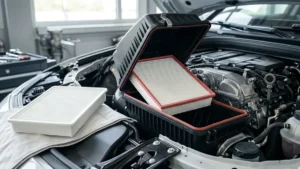
Your car needs a steady supply of clean air to run properly. The engine air filter catches dust, dirt and other debris before they enter the engine. A separate cabin air filter helps clean the air that flows into the passenger compartment.
This guide explains how both filters work, how to spot signs of a dirty filter, when to replace them and how to choose the right type. You’ll also find practical DIY instructions, cost estimates and answers to common questions.
Key takeaways
- Two types of air filters: The engine air filter protects the engine, while the cabin air filter cleans air entering the passenger compartment.
- Engine protection: A clean engine air filter helps prevent abrasive dirt and debris from entering the engine’s air intake.
- Fuel economy: Replacing a clogged filter can restore lost performance, but it usually doesn’t improve fuel economy in modern fuel-injected cars.
- Replacement intervals: The correct schedule depends on your vehicle, driving conditions and the manufacturer’s recommendations.
- Cabin air quality: A dirty cabin filter can reduce airflow through the heating and air conditioning system.
- Visual inspection: Check the filter for dirt, damage and excessive restriction. Don’t judge its condition by color alone.
What is a car air filter?
A car air filter uses paper, synthetic fibers or another filtration material to capture airborne contaminants. The engine air filter sits inside the intake system and cleans the air before it enters the engine. Most cars also have a cabin air filter. It sits in the heating, ventilation and air conditioning (HVAC) system and filters the air entering the interior.
Engine air filter vs. cabin air filter: What’s the difference?
What the engine air filter does

The engine air filter cleans incoming air before it reaches the engine’s combustion chambers. It’s usually located under the hood inside an air intake housing.
By trapping dust, grit and other debris, the filter helps protect internal engine components from abrasive particles. A damaged, poorly fitted or heavily restricted filter can affect engine performance.
What the cabin air filter does
The cabin air filter cleans air entering the passenger compartment through the HVAC system. Depending on the vehicle, you’ll find it behind the glove box, beneath the dashboard or in another part of the ventilation system.
It can capture particles such as pollen, dust and soot. Some versions also contain activated carbon to help reduce certain odors and gases.
Quick comparison table
| Feature | Engine air filter | Cabin air filter |
|---|---|---|
| Typical location | Under the hood, inside the air intake housing | Behind the glove box, under the dashboard or elsewhere in the HVAC system |
| Main purpose | Protects the engine from airborne debris | Filters air entering the passenger compartment |
| Common shapes | Flat panel, round or conical | Usually a flat, rectangular panel |
| Typical replacement timing | Depends on the vehicle and driving conditions | Depends on the vehicle, filter type and driving conditions |
| Approximate part cost | $10–$100 | $10–$70 |

How a car air filter works
Many automotive air filters use pleated paper or synthetic filter media. The folds increase the available surface area, allowing the filter to capture particles while air passes through. A frame and sealing material hold the filter in place. A proper fit matters because gaps around the edges can allow unfiltered air to bypass the filter.
As the filter collects dirt, airflow can become restricted. Replacing it at the recommended interval helps maintain proper airflow and filtration.
Why a clean car air filter matters
It helps protect your engine
Clean car air filters protect your engine. Dust and grit can act like abrasives when they enter an engine. A properly fitted engine air filter helps keep these particles out, reducing the risk of wear to components such as cylinder walls, pistons and piston rings.
It helps maintain acceleration
An engine needs sufficient airflow to produce power. A heavily clogged air filter can restrict that airflow and reduce acceleration, particularly when the engine needs more air under load.
Research supported by the U.S. Department of Energy found that clogged intake filters reduced full-power acceleration in the tested vehicles. The results depended on the vehicles and test conditions, so a specific percentage improvement shouldn’t be expected from every filter replacement.
Does a new car air filter improve fuel economy?
The answer depends partly on the type of engine.
Modern fuel-injected cars: Replacing a clogged air filter generally doesn’t produce a meaningful improvement in fuel economy. Research has found that restricted filters can reduce acceleration without measurably changing fuel economy in modern gasoline and diesel vehicles.
Older carbureted cars: A clogged filter can affect the air-fuel mixture and reduce fuel economy. Older studies reported mileage losses of around 2%–6% under some conditions, with larger losses reported in severe cases. These figures shouldn’t be applied to every older vehicle.
Replace a dirty filter when needed, but be cautious of aftermarket products promising major fuel savings.
It helps maintain cabin air quality
A cabin air filter can capture pollen, dust, soot and other airborne particles entering the vehicle.
It helps maintain cabin air quality. Some filters also contain activated carbon to help reduce certain odors. A clean filter supports the ventilation system, but its effectiveness depends on the filter’s design and condition. It doesn’t guarantee that all pollutants, gases or biological particles will be removed.
Signs your car air filter needs replacing
Signs of a dirty engine air filter
Look for these possible warning signs:
- Slower acceleration or reduced engine response.
- Reduced power when accelerating or passing on the highway.
- Visible dirt buildup, damaged pleats or tears in the filter material.
- A filter that’s reached the replacement interval specified by the manufacturer.
These symptoms can have other causes, so don’t assume the air filter is responsible without checking it.
Signs of a dirty cabin air filter
A clogged cabin filter may cause:
- A persistent musty smell from the vents.
- Weak airflow even when the fan is set to a high speed.
- Windows that take longer than usual to clear.
- Reduced heating or cooling airflow.
- More visible dust around the cabin vents.
If these problems continue after replacing the filter, have the HVAC system checked for other issues.

How to inspect an engine air filter
Start by checking the filter’s condition and comparing it with the maintenance guidance in your owner’s manual. Look for excessive debris, damaged material or a poor seal. Some people use a bright-light test to check whether light passes through the filter media. However, this isn’t a reliable replacement for the manufacturer’s inspection procedure. Filter construction and design vary, so don’t decide whether a filter is reusable based on this test alone.
A dark filter isn’t automatically unusable, and a filter that looks clean isn’t necessarily performing properly.
How often should you change a car air filter?
There isn’t one replacement interval that works for every vehicle. Automakers and service providers publish different schedules based on engine design, filter type and expected driving conditions.
Engine air filter replacement interval
The article’s original reference figures include:
- Jiffy Lube: 15,000–30,000 miles.
- AAA: Around 20,000 miles or more under some cleaner driving conditions.
- Some factory service schedules: 30,000–50,000 miles under specified normal driving conditions.
These are general reference ranges, not universal recommendations. Your vehicle’s owner’s manual should take priority, especially if it specifies inspection intervals or shorter replacement schedules for severe driving conditions.
Replacing a filter too early can waste money, but waiting too long can allow excessive restriction or compromise filtration.
Cabin air filter replacement interval
Some vehicles use intervals around 12,000–15,000 miles or approximately once a year. Others allow longer intervals.
Check the owner’s manual for the correct schedule. You may need to inspect or replace the filter sooner if you regularly drive through dusty areas, heavy traffic, polluted streets or places with high pollen levels.
Replacement intervals by driving conditions
The following table gives rough inspection and replacement-planning estimates. It isn’t a substitute for your vehicle’s service schedule.
| Driving environment | Engine air filter | Cabin air filter |
|---|---|---|
| Normal or highway driving | Follow the manufacturer’s interval; some schedules reach 30,000 miles or more | Follow the manufacturer’s interval; some schedules use annual replacement |
| Heavy city traffic or smog | Inspect more frequently and replace as specified | Inspect more frequently, especially if airflow or odor changes |
| Dusty roads or rural driving | Inspect often; replacement may be needed earlier than the normal interval | Inspect often; dust can shorten service life |
Do activated carbon cabin filters wear out faster?
Activated carbon filters contain material that helps adsorb certain odors and gases. Their performance can decline as the carbon becomes saturated, but the rate depends on exposure, filter design and use. Don’t assume every carbon filter loses its odor-control ability after exactly one year. Follow the replacement guidance for the specific filter and vehicle.
Types of car air filters
Paper filters (standard OEM)
Paper or cellulose-based filters are common in factory-installed intake systems. They’re generally affordable and designed for a particular vehicle’s airflow and filtration requirements. Most disposable paper filters should be replaced rather than washed or cleaned with compressed air. Follow the filter manufacturer’s instructions to avoid damaging the filter media.
Cotton gauze filters (oiled)
These reusable filters use layers of cotton gauze treated with oil. They’re sold as performance alternatives and require cleaning and re-oiling according to the manufacturer’s instructions. Some products specify service intervals around 5,000 miles, but this isn’t a universal interval. Driving conditions and the filter’s design affect how often maintenance is needed.
Foam filters
Foam filters are used in certain applications, including some off-road vehicles and specialized intake systems. Their filtration performance depends on the foam, construction and maintenance. Don’t assume every foam filter offers better protection in dusty conditions than a paper filter. Choose a product designed for your vehicle and intended use.

Cabin air filter types
Standard particulate filters: These capture common airborne particles, including dust and pollen.
Activated carbon filters: These add a carbon layer to help reduce certain odors and gases. Performance varies by product.
HEPA filters: A true HEPA filter is defined by its ability to capture at least 99.97% of particles measuring 0.3 microns under the relevant test conditions. That rating applies to HEPA filtration media, not to every automotive cabin filter. Check whether a vehicle can accept a properly fitted HEPA-rated filter before buying one.
No cabin filter should be assumed to eliminate all viruses or protect against every airborne contaminant. Performance depends on the filter, installation and ventilation system.
Are reusable filters worth it?
Reusable filters may reduce the need to buy replacement elements as often, but they require the correct cleaning and maintenance procedure. Some oiled filters can contaminate a mass airflow (MAF) sensor if too much oil transfers from the filter to the sensor. General Motors has documented this issue with excessively over-oiled aftermarket filters in certain vehicles.
This doesn’t mean every reusable filter will cause a problem. Follow the manufacturer’s instructions carefully and choose a filter compatible with your engine and intake system. For many everyday drivers, a correctly specified standard replacement filter is a straightforward option.
How to choose the right car air filter
1. Check your vehicle details
Confirm your car’s year, make, model and engine size. Different versions of the same model can use different filters. Use the owner’s manual, a reliable parts catalogue or the original filter’s part number to confirm compatibility.
2. Match the filter to your driving needs
A standard replacement filter is suitable for many everyday driving situations. If you drive off-road or in dusty environments, choose a filter designed for those conditions and follow its maintenance schedule. For cabin filtration, consider a particulate or activated carbon filter based on your needs and the options approved for your vehicle.
3. Be cautious about performance claims
Don’t assume a high-flow filter will automatically increase horsepower or improve fuel economy. Results depend on the engine, the existing intake system and the specific filter. A replacement filter should provide suitable filtration and airflow while fitting the vehicle correctly.
How to replace a car air filter (DIY)

Engine air filter: 5 steps
1. Open the airbox.
Turn off the engine and allow the engine bay to cool as needed. Locate the air intake housing under the hood, then release its clips or screws.
2. Remove the old filter.
Lift the cover carefully and take out the filter. Avoid knocking loose dirt into the clean side of the intake housing.
3. Clean the housing.
Use a clean cloth or suitable vacuum to remove loose debris. Keep dirt away from the intake opening and sensitive components.
4. Install the new filter.
Fit the replacement filter in the correct orientation. Check that the edges and seals sit evenly in the housing.
5. Secure the airbox.
Refit the cover and fasten all clips or screws. Make sure the housing closes properly and the filter is seated correctly.
Cabin air filter: 4 steps
1. Access the filter compartment.
Locate the cabin filter using your owner’s manual. It may be behind the glove box, under the dashboard or elsewhere in the HVAC system.
2. Open the access cover.
Release the appropriate clips or fasteners carefully. Some vehicles require additional trim removal.
3. Remove and replace the filter.
Slide out the old filter and clear loose debris from the compartment. Install the new filter in the direction shown by its airflow arrows or the vehicle’s instructions. The arrows don’t always point downward.
4. Reassemble the compartment.
Secure the access cover and refit any removed glove box or trim components.
Many cabin filter replacements take less than 15 minutes, although the time varies by vehicle.
When to call a mechanic
Consider professional help if the filter is difficult to reach, replacing it requires removing major dashboard panels or you’re unsure how to access the intake housing safely.
A technician can also help if poor acceleration, weak ventilation or unusual odors continue after the filter has been inspected or replaced.
Car air filter cost
The article’s original approximate part-cost ranges are:
- Engine air filter: $10–$100.
- Cabin air filter: $10–$70.
- Additional professional labor: The original estimate was $20–$50.
These are older estimates, not guaranteed current prices. The actual cost depends on your vehicle, filter brand, local labor rates and how difficult the filter is to access. Check current prices before budgeting for a replacement.
Frequently asked questions
Can I drive with a dirty car air filter?
You can often continue driving with a dirty filter for a short time, but a heavily restricted or damaged engine filter can affect performance and may compromise filtration. A clogged cabin filter can reduce ventilation airflow.
Inspect the filter and replace it when required by the manufacturer’s guidance.
Can I clean a paper air filter?
Most disposable paper filters should be replaced rather than washed or cleaned with compressed air. Cleaning can damage the filter material or affect its ability to trap particles. Always follow the instructions for the specific filter.
Do electric cars have an air filter?
Electric vehicles don’t need an engine air filter for combustion because they don’t have an internal combustion engine. However, many electric vehicles use cabin air filters to clean air entering the passenger compartment through the climate control system.
Will a performance air filter add horsepower?
It depends on the vehicle and intake setup. A replacement filter alone doesn’t guarantee a measurable horsepower increase, and a universal figure such as 1–5 hp can’t be promised for every car. Choose a filter for its compatibility, filtration and airflow characteristics rather than relying on an advertised power gain.
Does a cabin air filter affect AC performance?
Yes, a clogged cabin filter can restrict airflow through the HVAC system. You may notice weaker ventilation even when the fan is running at a high setting. If replacing the filter doesn’t restore normal airflow, the blower motor, evaporator or other HVAC components may need inspection.
Final thoughts
Regularly checking your engine and cabin air filters is a simple part of vehicle maintenance. Use the manufacturer’s replacement schedule, inspect filters for damage and excessive debris, and choose replacements that fit your vehicle correctly.
A clean engine air filter helps protect engine components, while a properly maintained cabin filter supports good ventilation and cleaner air inside the car.