
When it comes to compact SUVs, few comparisons are as competitive as Toyota RAV4 vs Honda CR-V. Both vehicles have built strong reputations for reliability, practicality, comfort, fuel efficiency, and everyday usability. They are also popular choices among families, commuters, and drivers who want the versatility of an SUV without stepping into a larger, more expensive vehicle
For 2026, the competition becomes even more interesting. Toyota has introduced an a ll-new sixth-generation RAV4 with a stronger focus on hybrid and plug-in-hybrid powertrains. Honda, meanwhile, continues to make the CR-V a practical and comfortable choice with gasoline and hybrid options.
So, which one is better?
The answer isn’t as simple as choosing one brand over the other. The RAV4 has some important advantages, especially when it comes to hybrid power, efficiency, and electrification. The CR-V counters with a spacious cabin, generous rear-seat room, and impressive cargo capacity.
In this Honda CR-V vs Toyota RAV4 comparison, we’ll look at the areas that matter most to SUV buyers, including performance, fuel economy, interior comfort, dimensions, cargo space, technology, family practicality, and hybrid capability.
By the end, you’ll have a much clearer idea of whether the 2026 RAV4 or CR-V is the right SUV for you.
The 2026 Toyota RAV4 and 2026 Honda CR-V are both excellent compact SUVs, but they take slightly different approaches.
The RAV4 is particularly attractive to buyers interested in electrification. Toyota’s 2026 RAV4 lineup is centered around hybrid and plug-in-hybrid models, giving buyers more ways to prioritize efficiency. The RAV4 Hybrid produces up to 236 net combined horsepower, while applicable models can achieve up to 47 mpg city and 40 mpg highway.
The Honda CR-V focuses heavily on comfort and practicality. It offers generous passenger space and up to 76.5 cubic feet of maximum cargo capacity, making it a strong choice for families and people who frequently carry luggage, groceries, sports equipment, or other bulky items.
The biggest differences can therefore be summed up like this:
RAV4: better for hybrid power, fuel efficiency, and electrification.
CR-V: better for interior space, cargo capacity, and family practicality.
Neither SUV is a clear winner in every category. Your priorities will ultimately determine which one makes more sense.
The first thing you’ll notice about the two SUVs is that they have different personalities.
The RAV4 has traditionally followed a more rugged design philosophy. Its exterior emphasizes a tougher SUV appearance, with higher-looking proportions and styling intended to appeal to drivers who want something more adventurous.
For 2026, Toyota has completely redesigned the RAV4 as a new sixth-generation model. The redesign gives it a more modern appearance while maintaining the SUV’s recognizable character. Toyota has also made electrification central to the new lineup.
The CR-V takes a somewhat different approach.
Honda’s design is more understated and refined. It doesn’t try as hard to look rugged, instead emphasizing a clean, sophisticated appearance. This makes the CR-V equally comfortable in an urban environment, suburban neighborhood, or on a family road trip.
Which design is better is obviously subjective.
If you prefer a more rugged and distinctive SUV appearance, the RAV4 may appeal more to you. If you like a cleaner and more sophisticated design, the CR-V may be the better fit.

Size is important when choosing a compact SUV because exterior dimensions affect everything from parking to passenger comfort and cargo capacity.
The CR-V is longer than the RAV4, measuring approximately 184.8 inches compared with the RAV4’s 181.0 inches. The Honda is also slightly wider.
However, exterior size doesn’t tell the whole story.
The biggest difference becomes noticeable inside the cabin. The CR-V offers approximately 41.0 inches of rear legroom, giving rear passengers plenty of space. The RAV4 provides approximately 37.8 inches of rear legroom.
That difference could matter considerably if you regularly carry adults in the back seat.
For a couple who rarely uses the rear seats, it probably won’t be a major concern. But for families with teenagers or adults who frequently travel in the second row, the CR-V’s additional space is a meaningful advantage.
| Feature | 2026 Toyota RAV4 | 2026 Honda CR-V |
| Length | 181.0 in | 184.8 in |
| Width | 73.0 in | 73.5 in |
| Wheelbase | 105.9 in | 106.3 in |
| Front legroom | 41.0 in | 41.3 in |
| Rear legroom | 37.8 in | 41.0 in |
| Maximum cargo capacity | Up to 70.4 cu. ft. | Up to 76.5 cu. ft. |
| Hybrid horsepower | Up to 236 hp | 204 hp |
| Best hybrid fuel economy | Up to 43 mpg combined | Up to 40 mpg combined |
Specifications can vary depending on trim and drivetrain.
Dimension winner: Honda CR-V

An SUV can have excellent specifications on paper and still disappoint if its interior isn’t comfortable.
Fortunately, both the RAV4 and CR-V perform well here.
The 2026 RAV4 receives a redesigned cabin with updated technology and a more modern dashboard. Toyota has clearly aimed to make the new RAV4 feel more sophisticated while retaining the practicality expected from the model.
The CR-V’s interior has a different strength: usability.
Honda has designed the CR-V around passengers and everyday functionality. The rear seats are especially impressive because of their generous legroom.
For long journeys, this can make a noticeable difference.
Imagine a family taking a six-hour road trip. The driver and front passenger may be perfectly comfortable in either SUV, but rear passengers could appreciate the CR-V’s additional legroom.
The CR-V also provides plenty of useful storage areas throughout the cabin, which is another advantage for families.
The RAV4 isn’t uncomfortable by any means. It simply doesn’t provide quite the same rear-seat space as the Honda.
Interior comfort winner: Honda CR-V
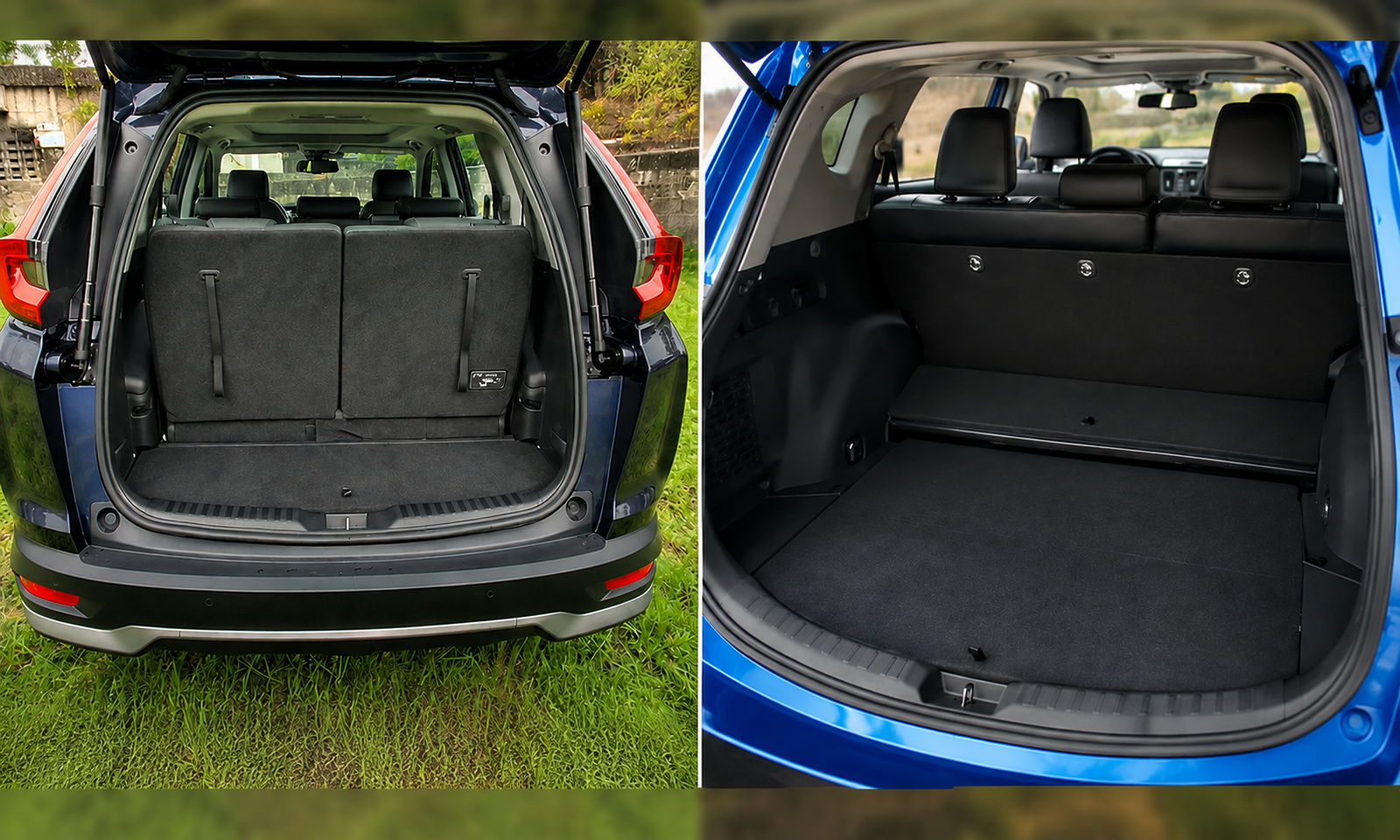
If you’re specifically searching for RAV4 vs CR-V cargo space, this is another category where Honda has an advantage.
The CR-V provides up to 76.5 cubic feet of maximum cargo capacity with the rear seats folded. The RAV4 offers up to approximately 70.4 cubic feet, depending on configuration.
On paper, the difference may not look enormous. In everyday life, however, those extra cubic feet can become useful.
Think about the things people actually put inside their SUVs:
The CR-V’s larger cargo area gives it more flexibility when you’re carrying bulky items.
The RAV4 remains highly practical, but if maximum cargo capacity is one of your biggest priorities, Honda has the advantage.
Cargo-space winner: Honda CR-V
Performance is where the RAV4 starts to pull ahead.
The 2026 RAV4 Hybrid produces up to 236 net combined horsepower. The CR-V Hybrid produces 204 horsepower.
That’s a noticeable difference.
Most compact-SUV buyers aren’t looking for sports-car acceleration, but additional power can still make everyday driving more enjoyable.
More power can be useful when:
The CR-V Hybrid is still perfectly capable for normal commuting and family driving. Honda has prioritized smoothness and efficiency rather than outright performance.
But if you’re asking which hybrid SUV is more powerful, the answer is clearly the RAV4.
Performance winner: Toyota RAV4
Fuel economy is one of the most important reasons buyers consider hybrid SUVs.
Both vehicles perform well, but the RAV4 has an advantage.
Toyota lists up to 47 mpg city and 40 mpg highway for applicable 2026 RAV4 Hybrid configurations.
The CR-V Hybrid is also efficient, with applicable front-wheel-drive versions rated at up to 43 mpg city and 36 mpg highway.
For drivers who cover a lot of miles, those numbers can make a meaningful difference over time.
Suppose you’re commuting every day and driving thousands of miles annually. Even a few miles per gallon can translate into fewer visits to the fuel station and lower fuel costs over the life of the vehicle.
The exact difference will depend on your trim, drivetrain, traffic, weather, and driving habits, but the RAV4 has the stronger maximum fuel-economy numbers.
Fuel-economy winner: Toyota RAV4
The RAV4 vs CR-V Hybrid comparison is particularly interesting for 2026.
Toyota has made hybrid technology a central part of the new RAV4 lineup. In addition to traditional hybrid models, Toyota offers plug-in-hybrid versions, giving buyers more electrification options.
Honda also offers a hybrid CR-V, but it doesn’t currently provide the same plug-in-hybrid choice.
This makes the RAV4 particularly interesting for drivers who want to move further toward electrification without necessarily switching to a fully electric SUV.
The CR-V Hybrid remains a strong choice for someone who simply wants better fuel economy without changing their normal driving routine.
If you want the broader electrified lineup, Toyota has the advantage.
Hybrid/electrification winner: Toyota RAV4
The two SUVs also feel slightly different behind the wheel.
The RAV4’s stronger hybrid powertrain gives it a more energetic character. Drivers who like having extra power available under the accelerator will probably appreciate the Toyota.
The CR-V is more focused on relaxed driving. Its steering, ride, and powertrain are well suited to commuting and family trips.
Neither is intended to be a performance SUV.
Instead, the difference comes down to personality.
The RAV4 feels like the choice for someone who wants a little more strength and versatility from their compact SUV.
The CR-V feels like the choice for someone who wants a comfortable and predictable daily driver.
Modern SUV buyers expect much more than basic transportation, and both manufacturers understand that.
The 2026 RAV4 comes with Toyota’s newer Toyota Safety Sense 4.0 suite and updated infotainment technology. Toyota has also increased the technology available throughout the redesigned RAV4 lineup.
Honda continues to use its Honda Sensing suite of driver-assistance technologies in the CR-V.
Depending on trim, both SUVs can offer features such as:
The exact equipment depends heavily on trim level.
Therefore, rather than choosing based solely on the brand, buyers should compare the specific trims they can afford.
A base RAV4 and a high-end CR-V, for example, can have very different equipment levels.
Technology and safety: Tie
For families, the CR-V deserves serious consideration.
Its combination of rear-seat space and cargo capacity makes it particularly practical for everyday family life.
Parents may appreciate the extra cargo room for strollers and groceries. Teenagers and adult passengers can benefit from the generous rear legroom.
The RAV4, however, has a different family advantage: efficiency.
If your family drives a lot every week, the RAV4 Hybrid’s strong fuel economy can become a major benefit.
That makes the decision relatively straightforward.
Choose the CR-V for maximum family space.
Choose the RAV4 Hybrid for efficiency and stronger performance.
There isn’t a single answer that works for everyone.
The good news is that both are sensible choices.
Your best option comes down to what you expect from your SUV every day.
The Toyota RAV4 vs Honda CR-V comparison doesn’t produce one winner in every category. Instead, each SUV is better suited to a slightly different type of buyer.
The 2026 Toyota RAV4 is the stronger choice if you care most about hybrid power, fuel economy, and electrification. Its 236-horsepower hybrid system and impressive fuel-economy figures make it particularly appealing to drivers who want efficiency without giving up performance.
The 2026 Honda CR-V makes a stronger argument when space, comfort, and practicality are the priorities. Its generous rear-seat legroom and larger maximum cargo area make it an excellent option for families and road-trip drivers.
So, which should you buy?
If you’re searching for RAV4 vs CR-V Hybrid and want the stronger combination of power and efficiency, the RAV4 gets the edge.
If you’re comparing RAV4 vs CR-V dimensions or RAV4 vs CR-V cargo space because you need a comfortable family vehicle with plenty of room, the CR-V is the better choice.
Ultimately, both SUVs are excellent all-rounders. The right choice isn’t necessarily the one with the most impressive specification sheet—it’s the one that best matches your budget, lifestyle, passengers, driving habits, and priorities.
The RAV4 is better for buyers who prioritize hybrid performance, fuel economy, and electrification. The CR-V is better for buyers who want more passenger and cargo space. Neither is universally better.
The Honda CR-V has more maximum cargo space. It offers up to 76.5 cubic feet, while the RAV4 offers up to approximately 70.4 cubic feet depending on configuration.
The RAV4 Hybrid has the advantage in horsepower and maximum fuel economy. The CR-V Hybrid counters with greater interior and cargo practicality. Your priorities should determine which hybrid is better for you.
The Toyota RAV4 Hybrid has the highest maximum fuel-economy ratings. Applicable 2026 RAV4 Hybrid models can reach up to 47 mpg city and 40 mpg highway.
The CR-V is actually longer and slightly wider than the RAV4. However, exterior dimensions don’t tell the entire story. The CR-V also provides more rear legroom and maximum cargo capacity.