Key Takeways
- Suburban offers better family value
- Wagoneer L leads in towing power
- Chevy provides more cargo space
- Suburban starts at a lower price
- Jeep focuses on luxury and performance
- Chevy offers diesel engine option
- Suburban wins in practicality and versatility
The choice of the best premium extra-long full-size SUV is the largest power move you can make when you have a big family in tow and more than one butt to boil for comfort, or cause for capability. Here, two titans of lock-to-lock legroom duel for supremacy in the ultra-exclusive highway cruiser class where bulk is a badge and wheelbases are engineered to haul a family along with all their baggage. In this head-to-head battle, we compare the mighty Chevrolet Suburban against the extended Jeep Wagoneer L to see which one of these titans impacts the road better.
So you have a straight-choice pickup on what to choose between, the dueling suburban vs wagoneer. According to our data on the family-vehicle segment, real-world cabin logistics, a lower entry price, and good old-fashioned mechanical simplicity gives the Chevy Suburban overall family bragging rights. But if you want to make a statement, the Jeep Wagoneer L sure can with its high max trailering limits and stout engine torque.
We at ChevySUV understand that juggling a busy family life calls for a vehicle with mobile command center functionality. So, let us dig into the specs and see which long-hood cruiser should find a home in your driveway.
Price and Trim Level Value
Your financial architecture is what you use to invest in a vehicle this well-established. An overview of the typical suburban vs wagoneer price rationale suggests that while both brands move up toward premium, they start from wildly different bases in terms of cost consciousness and market aspirations.
The 2026 Chevy Suburban is closer to a snag baseline, with an entry-level trim level LS estimated MSRP of $63,700. For a perfect family comfort-tech balance, the super popular LT starts just under $66,700, then the rugged Z71 and sporty RST range between $71,000–$74,000. Premium luxury buyers can step up to the Premier or top-line High Country model, which starts with an estimated price tag of $83,700 and comes adorned in real wood trim, custom stitching, and drink-stirring magnetic ride controls.
Jeep’s extended-length lineup is designed with the high-end buyer in mind, so your entry to the game won’t come cheap. When looking closely at the suburban vs wagoneer price dynamics, pricing for the 2026 Jeep Wagoneer L starts at roughly $67,000. The price also quickly climbs beyond $92,000 as you go through the Series II and Series III trim walks, or if you want to upgrade to the ultra-luxurious suburban vs grand wagoneer tier of luxury with the Grand Wagoneer L—which peaks over $100k in Summit Reserve models.
Cargo Capacity and Interior Layouts
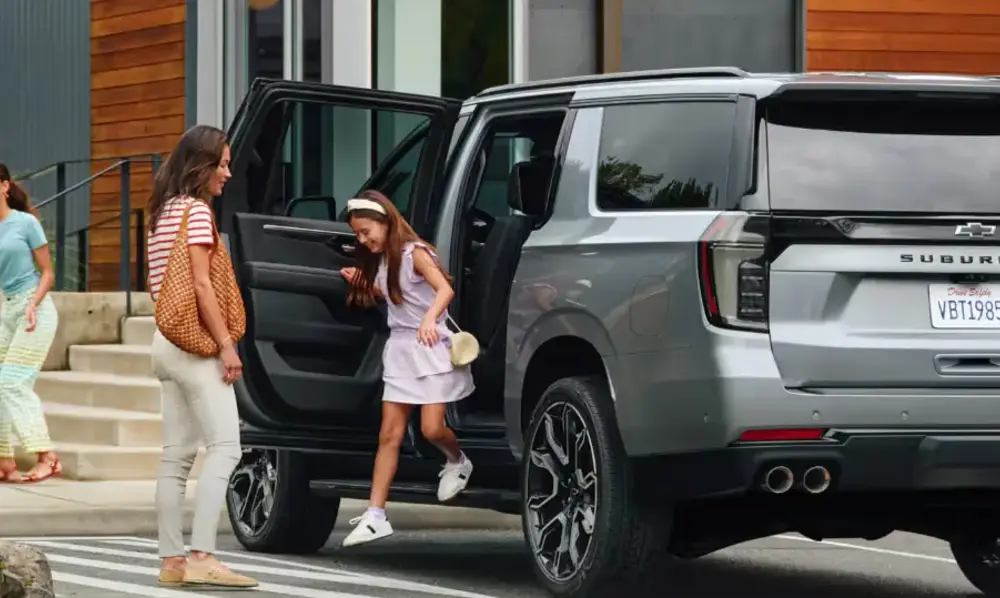
Selecting a stretched full-size over a standard one? It’s for the third row and trunk space. Looking at the suburban vs wagoneer interior packaging shows how each brand handled these massive interior dimensions.
The Suburban Interior Layout
Chevy Suburban: Essentially the benchmark for use of interior layout. In any evaluation of the suburban vs wagoneer interior, the Suburban stands out with an exceptionally low, entirely flat floor across the entire cabin thanks to its very compact independent rear suspension system. It boasts an industry-leading 144.5 cubic feet of maximum cargo space with the rear seats folded flat.
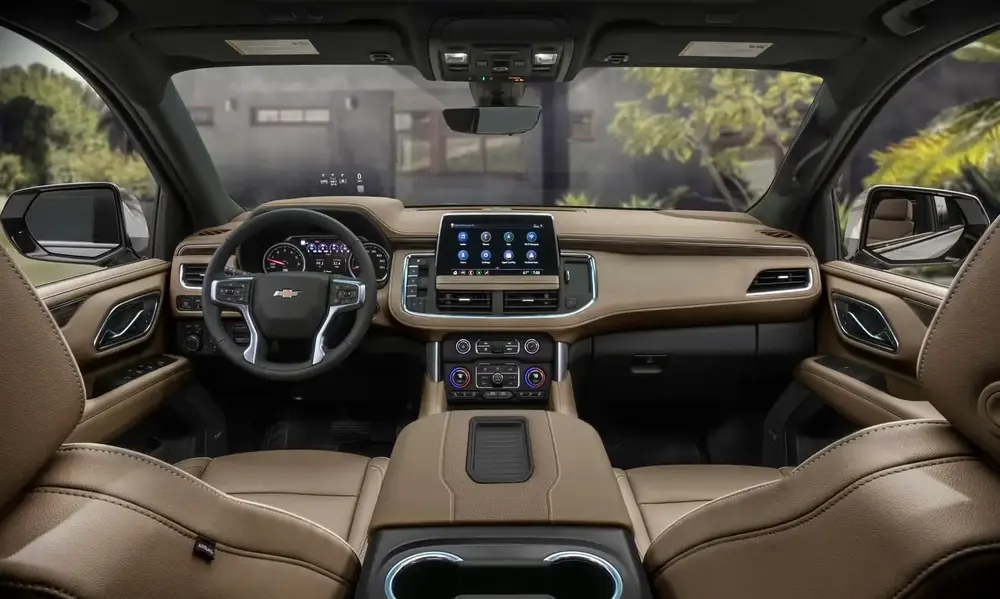
There’s an adult-friendly 36.7 inches of legroom for third-row passengers as well, so even the tallest family members shouldn’t have a problem on long hauls. At the center of the dashboard is a stunning, standard 17.7-inch touchscreen that manages all navigation and media functions effortlessly.
The Wagoneer L Interior Layout
That’s a significant size advantage for the Jeep Wagoneer L, which uses its additional length to offer more than 40 cubic feet of cargo space behind its third row and helpful bits at every corner. But thanks to its structural floor and folding seat mechanisms, the total suburban vs wagoneer interior volume comparison shows the Wagoneer L is capped at 130.9 cubic feet (with all rear seats in the flat position), which does not make for as wide an opening as the well over 100 cubic feet of open hold like we find in the Suburban.
The interior of the Wagoneer L focuses on a traditional layout, with a 10.1-inch screen standard (either touchscreen or not) in the middle of the dash plus an optional front-passenger display screen for even more money.
Powertrains and Towing Performance
Well, this being a monumentally huge frame requires some serious mechanical muscle under the hood. When assessing the suburban vs wagoneer l mechanical layouts, both are multi-engine flexible and quad turbocharging configurable.
Chevy Suburban Engine Lineup
The entire point of Chevrolet’s reasoning is to give you options that are suited to your driving style. In the suburban vs wagoneer l matchup, the Suburban features a standard 5.3-liter EcoTec3 V8 that generates 355 horsepower and 383 pound-feet of torque. Those seeking extra muscle can move up to the 6.2-liter V8 producing 420 horsepower and 460 pound-feet of torque, paired with an automatic-only drivetrain.
ChevySUV says, If highway cruising for long stretches in the future is your game, up to a 3.0-liter Duramax turbo-diesel engine can be found under the hood of Chevy products that boast impressive low-end pull and an astonishing range as well. When reviewing suburban vs wagoneer towing capabilities, an appropriately outfitted V8 Suburban can tow as much as 8,200 pounds, backed by an optional 14-view camera system and intelligent trailering app that keeps tabs on the tire pressures of your trailer.
Jeep Wagoneer L Powertrain
Nice to see Jeep doing this, replacing the V8 with fancy turbocharging. The Wagoneer L uses the Hurricane 3.0-liter twin-turbo inline-six, and in this configuration, we’re looking at a tag of 420 horsepower and 468 pound-feet of torque. The high-output variant of this twin-turbo engine is rated at as much as 510 horsepower when cross-shopped in the suburban vs grand wagoneer tier against the top-performing upscale models.
The Hurricane engine is capable of linear, smooth acceleration throughout the rev range. For buyers focused heavily on suburban vs wagoneer towing metrics, that strong torque helps the Wagoneer L reach up to 10,000 pounds of maximum tow rating when equipped with the heavy-duty trailering package. It’s a strong pull, but with no diesel engine available for long-range highway drivers, pump choices are more limited.
Long-Term Reliability and Maintenance
When purchasing a vehicle designed to stay in the family for years, real-world durability and ease of maintenance are essential factors to consider.
-
Chevrolet Small-Block Heritage: The V8 engines inside the Suburban are part of a legendary family of small-block motors that are highly understood by mechanics across North America. This traditional design keeps long-term maintenance costs predictable and ensures replacement parts are affordable and easy to source.
-
Jeep High-Tech Complexity: The twin-turbocharged Hurricane engine inside the Wagoneer L is a modern marvel, but its dual turbochargers, complex plumbing, and high-pressure direct injection systems mean specialized service is required down the road.
-
Factory Warranty Programs: Chevrolet provides a standard 3-year/36,000-mile bumper-to-bumper warranty paired with a 5-year/60,000-mile powertrain warranty. Jeep offers an identical coverage structure, leaving the suburban vs wagoneer l reliability choice down to your personal preference for mechanical simplicity versus high-tech turbocharging.
Advanced Safety and Highway Assist
Both manufacturers have integrated their most sophisticated driver-assist suites to ensure your family remains safe during long journeys across the country.
The Chevy Suburban offers an available class-leading Super Cruise driver assistance feature. This advanced system allows for true hands-free driving on more than 400,000 miles of pre-mapped highways across the United States and Canada, automatically handling lane changes and maintaining safe following distances while a driver monitoring camera ensures you keep your eyes on the road.
Jeep counters with its available Active Driving Assist system. While highly sophisticated and offering lane-centering technology alongside adaptive cruise control, it requires you to keep your hands on the steering wheel during operation. Both vehicles come standard with essential safety features, including automatic emergency braking, blind-spot monitoring, and rear cross-path alerts.
The Verdict: Icon Utility Wins the Showdown
While both of these extended-length vehicles represent the absolute pinnacle of full-size capability, the final decision comes down to your family’s daily requirements. The Jeep Wagoneer L is an exceptional choice if your lifestyle demands a 10,000-pound maximum towing capacity and you prefer the punchy feel of a twin-turbocharged inline-six engine.
However, the Chevy Suburban wins this premium suburban vs wagoneer showdown. An extended full-size SUV’s primary purpose is to deliver space and flexibility without compromise. By offering a lower initial starting price, a massive flat-floor cargo hold that outpaces the Jeep by over 13 cubic feet, a standard 17.7-inch screen, and available hands-free Super Cruise technology, the Suburban continues to reign as the ultimate family hauler.
Frequently Asked Questions
What is the main difference in cargo room between the Suburban and Wagoneer L?
The difference comes down to cabin packaging. The Chevy Suburban features a low, flat floor that provides up to 144.5 cubic feet of maximum cargo space with all rear rows folded. The Jeep Wagoneer L features a slightly taller rear floor structure, which limits its maximum cargo capacity to 130.9 cubic feet.
How does the suburban vs wagoneer towing capacity compare?
In this specific category, the suburban vs wagoneer towing showdown holds an edge for Jeep, with the Wagoneer L reaching a maximum towing capacity of up to 10,000 pounds when properly equipped. The Chevy Suburban maxes out at a highly capable 8,200 pounds, which is more than enough to pull large family boats, horses, or campers.
Can you get a diesel engine in the Chevy Suburban or Jeep Wagoneer L?
The Chevy Suburban offers an available 3.0-liter Duramax turbo-diesel inline-six engine, which provides exceptional fuel efficiency and an outstanding driving range on the highway. The Jeep Wagoneer L does not offer a diesel option, relying solely on its twin-turbo gas engine.
What is the primary difference in the suburban vs grand wagoneer comparison?
The standard Wagoneer L competes directly with mid-to-high trim levels of the Suburban. When comparing the suburban vs grand wagoneer L, you are stepping into true ultra-luxury territory. The Grand Wagoneer L features a more powerful 510-horsepower engine, high-end interior leather options, and up to 75 inches of total digital display screens throughout the cabin, competing with luxury brands at a much higher price point.
Which vehicle features a larger standard dashboard display screen?
The Chevy Suburban comes standard with a class-leading 17.7-inch diagonal infotainment touchscreen across its entire lineup. The Jeep Wagoneer L comes equipped with a standard 10.1-inch center screen, requiring buyers to upgrade to premium packages to get larger digital display layouts.